What can Ms. Rollison do to modify Joseph’s behavior?
Page 10: Maximize Intervention Success
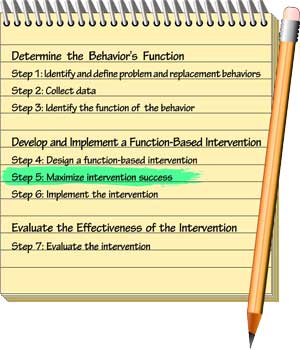
Once the function-based intervention has been designed—but before implementation begins—the team must consider three additional plan components that can help ensure success:
- Social validity
- Implementation fidelity
- Generalization and maintenance
Social Validity
Social validity refers to whether the proposed intervention and the desired replacement behavior represent socially accepted practices. Discussions with team members, or the use of simple forms, at the onset of the intervention can determine whether those involved (e.g., teacher, parent, student) believe that the intervention is socially valid. Implementation is more likely to be conducted as intended if those involved feel that the intervention is socially valid. To determine social validity, the team members need to identify whether:
- The intervention will address socially significant goals
- Those involved with the intervention feel that it is socially acceptable
- The intervention will produce socially important outcomes
- The intervention features fit the teacher’s instructional style
- The teacher believes that the intervention is likely to work
 Reassessing social validity after the intervention is concluded can help the team determine whether the intervention addressed initial expectations with respect to the significant goals, socially acceptable procedures, and socially important outcomes. This also helps to determine whether the intervention can be transferred to other settings.
The items below illustrate the types of topics assessed on a social validity questionnaire. The items might be ranked using a five-point scale in which 1=Strongly Disagree and 5=Strongly Agree.
- The intervention focuses on an important behavior.
- The target behavior is of sufficient concern to warrant the use of this intervention.
- I believe that this intervention will produce effective results.
- I understand the intervention steps.
- The intervention is easily incorporated into my classroom system.
- I believe that I can accurately implement this intervention in my classroom.
- I have the necessary materials to implement this intervention accurately.
- The time requirements of this intervention are reasonable.
Implementation Fidelity
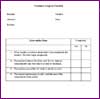
Implementation fidelity, also referred to as treatment integrity or intervention fidelity, is the degree to which the teacher implements the intervention as it was designed. Interventions may not work as expected when steps are added or omitted. Implementation fidelity data are particularly helpful when an intervention does not produce the desired outcomes, as it helps the team to determine whether a breakdown in the implementation of the intervention has occurred. When planning to assess implementation fidelity, the team should consider:
- What method of data collection to use (e.g., checklists, rating scales, self-reports, audio or video tapes)
- Who will collect the data (e.g., team members, preferably not just the person doing the implementation)
- How often the data will be collected (e.g., daily, three times per week, weekly)
Team members can develop a simple implementation fidelity form (such as the one above) by listing each step or component of the intervention. Ideally, implementation fidelity data should be collected daily, or as often as the intervention is implemented. However, factors such as time and the availability of resources may influence the frequency of data collection. Regardless, implementation fidelity data should be collected at least once per week.
Generalization and Maintenance
As they begin to develop their intervention plan, the team must consider how the student will eventually generalize and maintain the desired behavior. Generalization means that the student is able to transfer learned skills to new settings, with different people, and in varying contexts. In order to support the generalization of a desired behavior or skill, teachers can plan to:
- Provide training on the replacement behavior or skill in a variety of settings, with multiple people, and in different contexts
- Use the same antecedents and consequences across settings to encourage the generalization of behaviors
 Maintenance means that the student’s behavior is self-sustaining over time. When planning for the maintenance of a desired behavior or skill, teachers can:
- Select consequences that occur naturally in a school setting (e.g., verbal praise, good grades for accurate work)
- Select prompts that will gradually be faded as the student becomes more successful in engaging in the desired behavior
