How can educators determine why students are engaging in these behaviors?
Page 6: Descriptive Assessments
 In addition to gathering information from indirect assessments, FBA teams should collect real-time data to gain insight into the circumstances surrounding the target behavior. Descriptive assessments involve observing the student in the natural educational environment and systematically recording information when the target behavior occurs. Ideally, an objective person (e.g., school psychologist, another educator, behavior analyst) will conduct these observations while the teacher goes about their usual instruction. This helps ensure that the data reflect the natural environment and the ways educators and peers typically respond to the behavior.
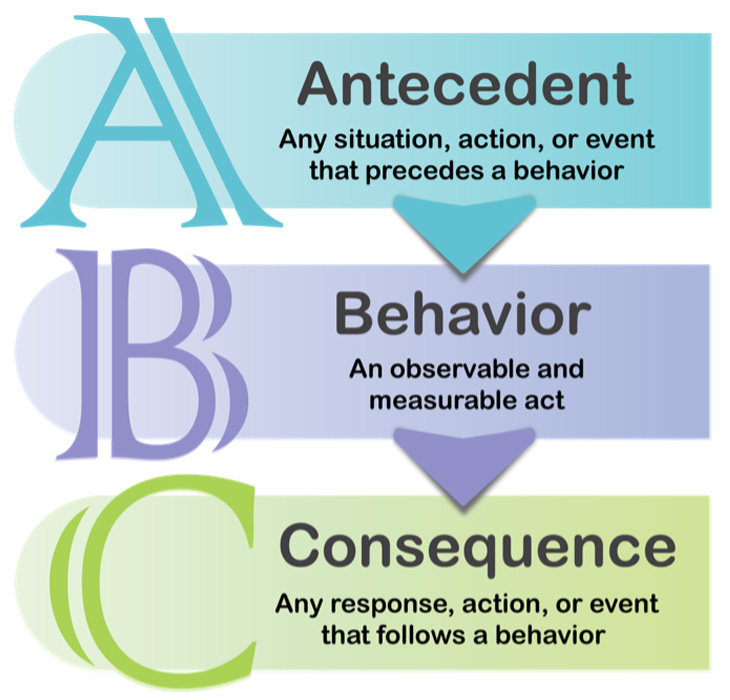
Most often, the descriptive assessment used for an FBA is antecedent-behavior-consequence (ABC) data collection. When collecting ABC data, the observer records the time, location, and a brief narrative for each observed instance of the target behavior as it occurs. This narrative is divided into three sections:
For Your Information
In addition to antecedents that occur just before the behavior, observers should also make note of any known setting events that are further removed from the behavior (e.g., confrontation with an adult outside of the classroom, not sleeping well the night before).
setting event
in glossary
- Antecedents: Any situations, actions, or events that happen before the behavior, including elements of the environment (e.g., instructional configuration, subject area) and any immediate triggers (e.g., an interaction with a peer, a loud noise, a transition).
- Behavior: Any observable and measurable act that aligns with the operational definition of the student’s target behavior.
- Consequences: Any responses, actions, or events that follow the behavior (e.g., teacher reprimands, peer reactions, incomplete work).
Note: Consequences refer to any change in the environment regardless of intent. It is important to record natural consequences as well as more deliberate actions taken to address the behavior.
natural consequence
in glossary
By recording specific details of what happened before and after the behavior, FBA teams can better distinguish what tends to trigger the target behavior in the moment and what reinforces it over time. Consider the descriptive data recorded for a single instance of a target behavior:
| Setting | Antecedent | Behavior | Consequence |
| Algebra class | The teacher says, “Jamie, please come to the board to solve problem number four.” | Jamie slams his book shut and groans loudly. | Other students laugh. The teacher says, “Jamie, it’s your turn to solve a problem.” |
Each occurrence of the target behavior should be recorded in its own row of the ABC data chart. Sometimes, behavior occurs in a sequence, with the consequence of one behavior acting as the antecedent for another. In the ABC chart below, notice how the teacher’s response (i.e., consequence) to Jamie’s initial behavior becomes the antecedent that triggers a second instance of the target behavior. Recording the ABCs of each incident separately helps to capture key details about how the behavior escalated.
| Setting | Antecedent | Behavior | Consequence |
| Algebra class | The teacher says, “Jamie, please come to the board to solve problem number four.” | Jamie slams his book shut and groans loudly. | Other students laugh. The teacher says, “Jamie, it’s your turn to solve a problem.” |
| Algebra class | The teacher says, “Jamie, it’s your turn to solve a problem.” | Jamie yells, “This is so stupid!” | The teacher says, “Okay, just work on it at your seat,” and calls on another student. |
Although a single behavioral instance might provide clues to its function, consistent data is needed to reveal trends. For this reason, multiple observations should be conducted so that ABC data are collected across different days and contexts until one or more patterns emerge. Such patterns are easier to recognize when ABC data are both thorough and precise. For example, narratives should specify any other people involved (e.g., educators, peers) and fully describe antecedents and consequences, even if they do not seem related to the behavior at first glance. Similarly, the narrative should detail exactly what the behavior looked or sounded like for each particular occurrence. When possible, it is also helpful to describe the duration and intensity of the behavior. It is far better to err on the side of including too much detail rather than too little, while taking care to prevent assumptions or misperceptions from impacting narrative descriptions.
In this interview, Bettie Ray Butler provides some considerations for educators when collecting ABC data (time: 2:40).
Bettie Ray Butler, PhD
Professor of Urban Education
University of North Carolina at Charlotte
Transcript: Bettie Ray Butler, PhD
Teachers and FBA teams should consider a few things when they are recording ABC data, the antecedent, the behavior, and the consequence. And critical self-reflection, introspection, is what I like to start with. And I know it seems out of place because we’re talking about the student’s behavior, but sometimes the antecedent behind the student’s behavior is the educator’s behavior. And so it’s always important to start with self first, to do a deep introspection of our own behaviors.
Secondly, observing classroom contexts and even desk arrangements. I know these are very simple things, but I think that they’re important when we’re talking about looking at these processes through a cultural lens because how desks are arranged could either indicate individualism or collaboration. And what they’re sitting on, and how long they’re sitting, and what is the front of the classroom versus the back of the classroom. How we design the classroom space to make it more comfortable and for it to be a space of collaboration and to encourage community I think it’s also important for FBA teams to consider. And knowing these things and being open to revising them and revising your ways of doing things, I think, will also show whether or not behaviors are more pronounced in this environment versus a separate environment.
And lastly, when you’re collecting this data, while pattern identification is critical in this process, but it’s not necessarily solely on the individual student, what is the teacher’s pattern of identifying these behaviors? What types of students are they identifying? Is there a disparity in the identification process and the subsequent consequences that immediately follow that process? Are they more punitive for certain students? Again, going back to that introspection, why do the teachers believe that this behavior exists in the first place? And then asking those very critical questions of, Is there data to support the reasoning why the teacher believes that this behavior exists? What outside of the teacher’s assumptions alone explain this behavior? Has the teacher done their due diligence and spoke with the families and spoke with the student to determine what may be happening in this situation?
Did You Know?
Behavior can be measured both qualitatively (using words) and quantitatively (using numbers). ABC data relies on qualitative notes about what happens before, during, and after an interfering behavior. Conversely, target behaviors can be measured quantitatively using systematic direct observations. Such data can take the form of:
systematic direct observation
in glossary
- Frequency recording—counting how many times the behavior happens in a given period
- Interval recording—documenting whether the behavior occurred during brief time intervals (e.g., 30 seconds)
- Duration recording—timing how long the behavior lasts
- Latency recording—documenting the time that elapses between when an instruction is provided and when the behavior begins or ends
Although systematic direct observation data can demonstrate how prevalent or severe a behavior is, they do not capture the context around the behavior (i.e., antecedents, consequences) that helps inform an understanding of its function. Therefore, qualitative ABC data are much more valuable for the purposes of an FBA. On the other hand, quantitative data from systematic direct observations are more beneficial for establishing a baseline and monitoring behavioral change once a BIP is implemented.
baseline
in glossary
Returning to the Challenge
 Tasha’s FBA team creates a plan for the FBA team leader (the school psychologist) to conduct regular observations and record ABC data. The video below depicts one such observation period. During the video, Johanna Staubitz records the ABCs of each instance of the target behavior, explaining each step and demonstrating how to fill out the recording form (time: 6:23). Note: Although educators should record the time each behavior occurs, for the purposes of this video, we only focus on how to record the antecedents, behaviors, and consequences.
Transcript: English
Narrator: ABC Data Collection, Tasha, English
Teacher: Okay, everyone, we’ve been working on our research papers for how social media influences our lives. I want you to get out your tablets and compile a list of references that you plan to use in your paper.
[Students begin working on their tablets. Tasha picks up her tablet and starts playing a game.]
[Teacher walks around and provides feedback to other students.]
Teacher: (to student at front table) Really good start on your references. Good job.
Teacher: (to student at Tasha’s table in back of classroom) Those look good. Keep going.
Teacher: (to student at side table out of frame) Love that reference.
[Teacher approaches Tasha.]
Teacher: Tasha, you need to get started on the assignment.
Tasha: I know. I am.
[Teacher walks away.]
[Tasha puts tablet down.]
Johanna: In this clip, we saw Tasha playing a game on her tablet, and that’s what we can write in the Behavior column. And then we ask ourselves, What happened before that? And we sort of have to go back in time because Tasha was playing that game on her tablet for a while. And you may even want to make a note, something like “about one minute.” It doesn’t have to be exact, just a guess, but just note that it was a while. And what had happened a little less than a minute before that was the teacher gave an instruction to the class to get out their tablets and compile a list of references for their assignment. So you can just write “teacher instruction” in the Antecedent column. As for consequence, the teacher eventually, again, after almost a minute, instructed Tasha to get started on her assignment. So you can write “teacher instruction” or “teacher redirect” in the Consequence column.
[One minute passes.]
[Tasha pulls out her phone and begins scrolling under the table.]
[The teacher approaches Tasha.]
Teacher: Tasha, please put your phone away.
[Tasha sighs heavily, puts her phone away, and puts her head in her hand.]
Johanna: In this clip, the antecedent was the consequence from the previous row. So you can just draw an arrow from the Consequences column down to the antecedent space in the next row. And the behavior we just saw from Tasha that followed that instruction was to get her phone out and be texting. So we can just write “phone out, texting,” some shorthand for that in the Behavior column. What happened next is the teacher came by and instructed Tasha to put her phone away.
[Teacher circulates the classroom and provides feedback to other students.]
Teacher: (to student at front table) This is a good one.
[Teacher walks by and taps on Tasha’s table.]
Teacher: You need to get busy.
Johanna: Once again, the consequence for the previous instance of target behavior is the antecedent for the next instance of the target behavior. So we can draw an arrow going across from consequence to antecedent in the next row. The behavior we see here from Tasha is sighing, putting her head on her hand, and looking off into the distance. So we can record that in the Behavior column. And the consequence we saw was another teacher redirection. That’s what we record in the Consequence column.
Tasha: Oh my gosh!
[Tasha pushes back from the table, knocking her notebook on the floor, and storms out of the classroom.]
[Teacher follows Tasha to the door.]
Teacher: Tasha!
[Teacher sighs heavily and presses intercom button to communicate with the office.]
Office worker: This is the office.
Teacher: Yes, hello. Tasha just left my classroom without permission. She’s headed down Hallway A. Can you please send Dr. Johnson to find her and talk to her about her behavior?
Office worker: Yes, will do.
Teacher: Thank you.
[Teacher begins circulating the classroom.]
Johanna: We see another cluster of target behaviors here, and the antecedent for these was the consequence for the previous instance of target behavior—that teacher redirection. So once again, draw an arrow from teacher redirection in the Consequences column down to the antecedent space in the next row. And the behavior we see here from Tasha is pushing paper off the table, saying “Oh my gosh!” and leaving the room. And you may want to note each of those things there or use shorthand. Lots of right ways to do that. And then the consequence for these more disruptive or more overt behaviors is that the teacher walked over and looked out the door after Tasha. And then she called the office, and we overhear that the principal is going to talk to Tasha about her behavior. And another way to put that—and we can write this in the Consequence column— is “Tasha left the classroom or escaped the classroom and is going to be spoken to by the principal.”
Johanna: So now that we’ve completed this ABC observation, we can look across our four rows of data we’ve recorded and start to think about a pattern. And first, we notice that each of her behaviors was followed by attention from the teacher. But if we look at all those things together, we see that ultimately they ended in her escaping the assignment. Taking into account also that a couple of these instances of behavior we recorded lasted about a minute—meaning she was playing a game on her tablet, she had her phone out texting, successfully escaping work for a relatively long period of time, a minute or so each time—really suggests that the work might be the real trigger and escaping from it the most important consequence or the potential reinforcer. And that doesn’t mean that that is the function of her behavior. This is just one source of data and there will be other ABC data measures that you collect. And all that needs to be looked at in conjunction with other sources of data, like interviews or systematic direct observation data. So just keep in mind there’s only one data point, but this pattern suggests escape.
Activity
 Now, let’s practice. First, review Isaiah’s target behavior.
Target behavior: Isaiah initiates forceful physical contact with inanimate objects.
Examples
- Isaiah pushes papers and objects off his desk.
- Isaiah kicks a backpack on the floor.
- Isaiah forcefully slams his hands or fists on a table.
- Isaiah throws a book.
Non-Examples
- Isaiah clenches his fists.
- Isaiah rearranges objects on his desk.
- Isaiah crumples a piece of paper.
- Isaiah bumps into a piece of furniture.
View the videos below to observe Isaiah’s behavior during two separate observational periods, in science and social studies class. As you review the videos, record each instance of Isaiah’s target behavior in the tables below.
Transcript: Science
Narration: ABC Data Collection: Isaiah – Science
Teacher (voice from background): Okay, class, time to put your tablets away. We’re going to get started.
[Isaiah grunts, throws his head back, and shakes his tablet.]
Isaiah: Ugh!
[Paraeducator places their hand on Isaiah’s table.]
Paraeducator: Isaiah, please find a stopping point so you can join us for the lesson.
Narrator: Two minutes later.
Isaiah continues using the tablet for two minutes.]
[After about two minutes, Isaiah puts the tablet down, opens his notebook, and begins writing.]
Transcript: Social Studies
Narration: ABC Data Collection: Isaiah – Social Studies
Teacher: Okay, friends. Thank you so much for working so hard on writing the responses to the end-of-the-chapter questions, but we are going to stop here because it’s time for us to discuss with a partner.
[Isaiah throws his pencil on the floor.]
Teacher: Let’s start with number one. Turn to your partner and let’s discuss.
[Students begin discussing with their partners.]
[Isaiah’s partner looks to him to discuss.]
[Isaiah pounds his fist on the desk and groans.]
Paraeducator: Isaiah, please pick up your pencil and put it back on your desk.
[Isaiah pushes the companion guide off his desk to the floor.]
Paraeducator: Hey, do you need to take a break?
[Isaiah does not respond but continues silently writing in his notebook.]
Note: Although you would typically record the time each behavior occurs, for the purposes of this activity, simply focus on recording the antecedents, behaviors, and consequences. As with any recording form, you might not use every row in the tables. These fields are provided for practice purposes only; your answers will not be available for downloading or printing.
Setting: Science class
| Antecedent | Behavior | Consequence |
Setting: Social Studies class
| Antecedent | Behavior | Consequence |
Setting: Science class
| Antecedent | Behavior | Consequence |
| The teacher directs students to put their tablets away. | Isaiah grunts, throws his head back, and shakes his tablet. |
The paraeducator places her hand on Isaiah’s table and asks him to find a stopping point. Note: Isaiah ignores her and continues on his tablet for two minutes before putting it down and opening his notebook on his own. |
Setting: Social Studies class
| Antecedent | Behavior | Consequence |
| The teacher tells students to stop what they’re doing because it’s time to discuss with partners. | Isaiah throws his pencil on the floor. | The teacher ignores Isaiah and instructs class to turn to their partners to discuss. |
| The teacher instructs class to turn to their partners to discuss, and Isaiah’s partner turns toward him. | Isaiah pounds his fist on the desk and groans. | The paraeducator comes to Isaiah’s side and asks Isaiah to pick up his pencil. |
| The paraeducator asks Isaiah to pick up his pencil. | Isaiah pushes the companion guide off his desk to the floor. |
The paraeducator asks Isaiah if he needs to take a break. Note: Isaiah ignores her, continues writing in his notebook, and does not participate in the partner chat. |

For additional information about content discussed on this page, view the following IRIS resources. Please note that these resources are not required readings to complete this module. Links to these resources can be found in the Additional Resources tab on the References, Additional Resources, and Credits page.
Behavioral Intervention Plans (Secondary): Developing a Plan to Address Student Behavior (page 8) This module explores the steps for developing a behavioral intervention plan. It includes identifying appropriate behaviors to replace the interfering behavior, selecting and implementing interventions that address the function of the behavior, monitoring students’ responses to the interventions, and making adjustments based on the data. Page 8 provides more information on systematic direct observation (est. completion time: 2 hours).
Measuring Behavior This Case Study Unit provides information on how to collect observational data on student behavior. Methods introduced include event, interval, duration, and latency recording. |