Please ensure Javascript is enabled for purposes of website accessibility Page 2: Improving Reading Comprehension
  • IRIS Center
  • Resources
    • IRIS Resource Locator
      Modules, case studies, activities, & more
    • Evidence-Based Practice Summaries
      Research annotations
    • High-Leverage Practices
      IRIS resources on HLPs
    • Films
      Portrayals of people with disabilities
    • Children's Books
      Portrayals of people with disabilities
    • Glossary
      Disability related terms
    • For PD Providers
      Sample PD activities, planning forms, & more
    • For Faculty
      Top tips, coursework planning, & more
    • Website Navigation Videos
      Getting around our Website & modules
    • New & Coming Soon
      Latest modules & resources
    • IRIS Archived Resources
      Modules, alignment tools, & more
  • PD Options
    • PD Certificates for Educators
      Our certificate, your PD hours
    • Log in to Your IRIS PD
    • For PD Providers
      Sample PD activities, planning forms, & more
    • IRIS+ School & District Platform
      A powerful tool for school leaders
  • Articles & Reports
    • Articles
      Articles about IRIS use & efficacy
    • Internal IRIS Reports
      Reports on IRIS use & accomplishments
    • External Evaluation Reports
      Evaluations of the IRIS Center
    • IRIS Stories
      Our resources, your stories
    • News & Events
      What, when, & where it's happening
  • Help
    • Help & Support
      Get the full benefit from our resources
    • Website Navigation Videos
      Getting around our Website & modules
  • CSR: A Reading Comprehension Strategy
Challenge
Initial Thoughts
Perspectives & Resources

What are some reasons to teach reading comprehension strategies in content-area classes?

  • 1: The Significance of Reading Comprehension
  • 2: Improving Reading Comprehension

What can teachers do to improve their students’ reading comprehension?

  • 3: Introduction to CSR
  • 4: Overview of the CSR Reading Strategies
  • 5: Preview Strategy
  • 6: Click and Clunk Strategy
  • 7: Get the Gist Strategy
  • 8: Wrap Up Strategy

How can reading comprehension strategies be implemented in content-area classes?

  • 9: Cooperative Learning
  • 10: Preparing the Class
  • 11: Materials for CSR
  • 12: Implementing CSR

Resources

  • 13: References, Additional Resources, and Credits
Wrap Up
Assessment
Provide Feedback

What are some reasons to teach reading comprehension strategies in content-area classes?

Page 2: Improving Reading Comprehension

Boy writing at his deskHaving decided to teach reading comprehension strategies to his science students, Mr. Dupree embarks on a journey to learn more. As he had suspected, good readers automatically use comprehension strategies, but poor readers do not. He learns, however, that these comprehension strategies can be taught to poor readers. To do so, Mr. Dupree will make use of the four elements described below.

  • Prior knowledge: Students are taught to think about what they already know about a particular topic. Next, students are asked to try to make a connection between their prior knowledge and the text they are reading.
  • Vocabulary development: Students are taught to use diagrams or graphic organizers to help them to learn and remember the meanings of new words.
  • Questioning techniques: Students are taught to generate questions before, during, and after reading. Students are asked to predict what they are going to read, to ask themselves during reading whether what they have read makes sense, and to generate questions about the text after reading.
  • Opportunities to practice new skills: Students are given ample time in the day for independent reading and are encouraged to share what they have read.
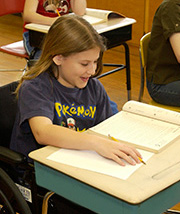
  

Happy girl at her desk

Good readers, like Sylvia, use various strategies to help them to organize, evaluate, and remember the information they encounter in expository texts. More specifically, before, during, or after reading, they may:

  • Clarify their purpose for reading
  • Make a plan for how to read the text
  • Connect information to their prior knowledge
  • Ask questions about the text
  • Monitor their comprehension


Girl struggling with reading

By contrast, poor readers, like Renee, lack knowledge of such strategies. They tend to comprehend little because they do not know how to make sense of the information they encounter in expository texts. Often, poor readers:

  • Focus on decoding words
  • Do not see connections among parts of the text
  • Do not realize that they do not understand what they have read
  • Do not understand the concept of reading for meaning

Print Friendly, PDF & Email
Back Next
12345678...13
Join Our E-Newsletter Sign Up
  • Home
  • About IRIS
  • Sitemap
  • Web Accessibility
  • Glossary
  • Terms of Use
  • Careers at IRIS
  • Contact Us
Join Our E-Newsletter Sign Up

The IRIS Center Peabody College Vanderbilt University Nashville, TN 37203 [email protected]. The IRIS Center is funded through a cooperative agreement with the U.S. Department of Education, Office of Special Education Programs (OSEP) Grant #H325E220001. The contents of this website do not necessarily represent the policy of the U.S. Department of Education, and you should not assume endorsement by the Federal Government. Project Officer, Anna Macedonia.

Copyright 2025 Vanderbilt University. All rights reserved.

* For refund and privacy policy information visit our Help & Support page.

Creative Commons License This work is licensed under a Creative Commons Attribution-NonCommercial-NoDerivatives 4.0 International License.

  • Vanderbilt Peabody College
We use cookies to ensure that we give you the best experience on our website. If you continue to use this site we will assume that you are happy with it.