


Heat induced temperature dysregulation and seizures in Dravet Syndrome/GEFS+ Gabrg2+/Q390X mice
- PMID: 28505490
- PMCID: PMC5512282
- DOI: 10.1016/j.eplepsyres.2017.04.020
Heat induced temperature dysregulation and seizures in Dravet Syndrome/GEFS+ Gabrg2+/Q390X mice
Abstract
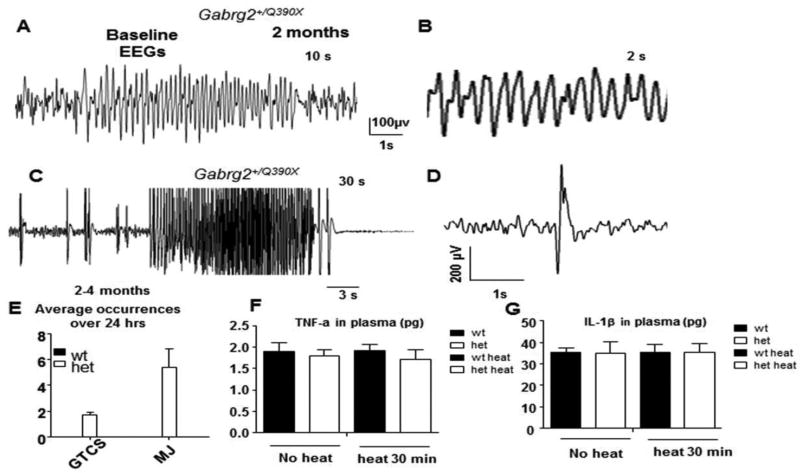
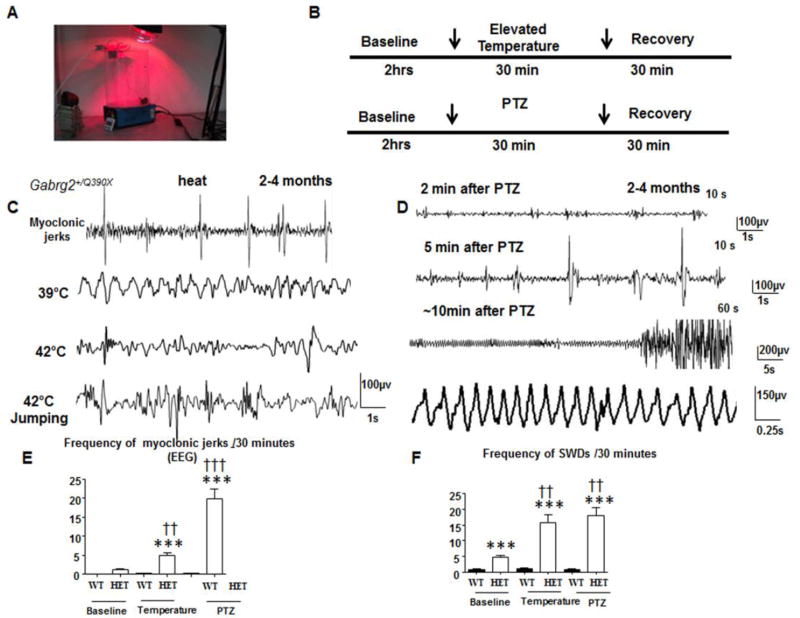
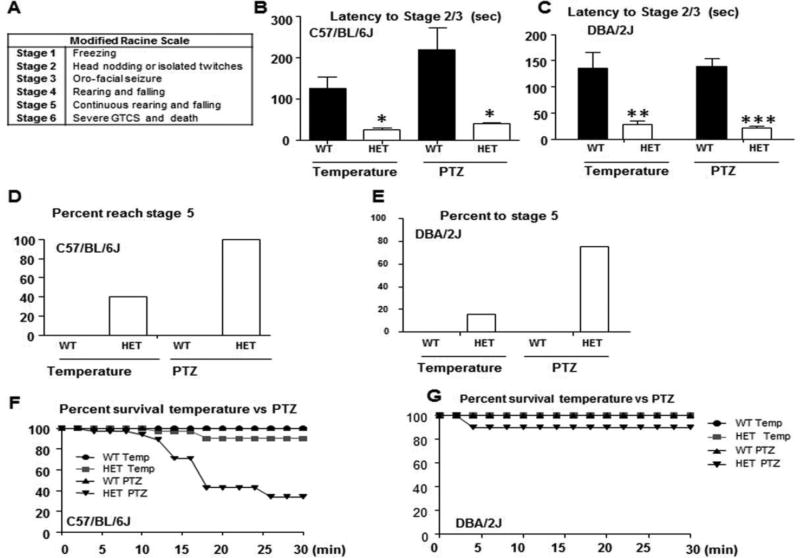
It has been established that febrile seizures and its extended syndromes like generalized epilepsy with febrile seizures (FS) plus (GEFS+) and Dravet syndrome have been associated with mutations especially in SCN1A and GABRG2 genes. In patients, the onset of FS is likely due to the combined effect of temperature and inflammation in genetically vulnerable individuals because fever is often associated with infection. Much effort has been spent to understand the mechanisms underlying fever induction of seizures. In addition to the role of cytokines in FS, previous studies in Scn1a+/- knockout mice, a model of Dravet syndrome, indicated that temperature elevation alone could result in seizure generation, and the effect of elevated temperature inducing seizures was age-dependent. Here, we report the thermal effect in a different mouse model of Dravet syndrome, the Gabrg2+/Q390X knockin mouse. We demonstrated age-dependent dysregulated temperature control and that temperature elevation produced myoclonic jerks, generalized tonic clonic seizures (GTCSs) and heightened anxiety-like symptoms in Gabrg2+/Q390X mice. The study indicated that regardless of other inflammatory factors, brief heat alone increased brain excitability and induced multiple types of seizures in Gabrg2+/Q390X mice, suggesting that mutations like GABRG2(Q390X) may alter brain thermal regulation and precipitate seizures during temperature elevations.
Keywords: Electroencephalography; Febrile seizures; GABRG2(Q390X) mutation; Generalized tonic clonic seizures; Myoclonic jerks; Temperature.
Copyright © 2017 Elsevier B.V. All rights reserved.
Conflict of interest statement
None of the authors has any conflict of interest to disclose. We confirm that we have read the Journal’s position on issues involved in ethical publication and affirm that this study is consistent with those guidelines.
Figures

References
-
- Duffner PK, Baumann RJ, Green JL. Febrile seizures: clinical practice guideline for the long-term management of the child with simple febrile seizures. American Academy of Pediatrics. Steering Committee on Quality Improvement and Management. Subcommittee of Febrile Seizures. Pediatrics. 2008;121:1281–6. - PubMed
-
- Gatti S, Beck J, Fantuzzi G, Bartfai T, Dinarello CA. Effect of interleukin-18 on mouse core body temperature. American Journal of Physiology-Regulatory, Integrative and Comparative Physiology. 2002;282:R702–R709. - PubMed
-
- Millichap JG. STUDIES IN FEBRILE SEIZURES I. Height of Body Temperature as a Measure of the Febrile-seizure Threshold. Pediatrics. 1959;23:76–85. - PubMed
-
- Mulley JC, Scheffer IE, Petrou S, Berkovic SF. Channelopathies as a genetic cause of epilepsy. Current opinion in neurology. 2003;16:171–6. - PubMed
Publication types
MeSH terms
Substances
Grants and funding
LinkOut - more resources
Full Text Sources
Other Literature Sources
Medical
Molecular Biology Databases
