


Prefrontal-Thalamic Anatomical Connectivity and Executive Cognitive Function in Schizophrenia
- PMID: 29113642
- PMCID: PMC5809301
- DOI: 10.1016/j.biopsych.2017.09.022
Prefrontal-Thalamic Anatomical Connectivity and Executive Cognitive Function in Schizophrenia
Abstract
Background: Executive cognitive functions, including working memory, cognitive flexibility, and inhibition, are impaired in schizophrenia. Executive functions rely on coordinated information processing between the prefrontal cortex (PFC) and thalamus, particularly the mediodorsal nucleus. This raises the possibility that anatomical connectivity between the PFC and mediodorsal thalamus may be 1) reduced in schizophrenia and 2) related to deficits in executive function. The current investigation tested these hypotheses.
Methods: Forty-five healthy subjects and 62 patients with a schizophrenia spectrum disorder completed a battery of tests of executive function and underwent diffusion-weighted imaging. Probabilistic tractography was used to quantify anatomical connectivity between six cortical regions, including PFC, and the thalamus. Thalamocortical anatomical connectivity was compared between healthy subjects and patients with schizophrenia using region-of-interest and voxelwise approaches, and the association between PFC-thalamic anatomical connectivity and severity of executive function impairment was examined in patients.
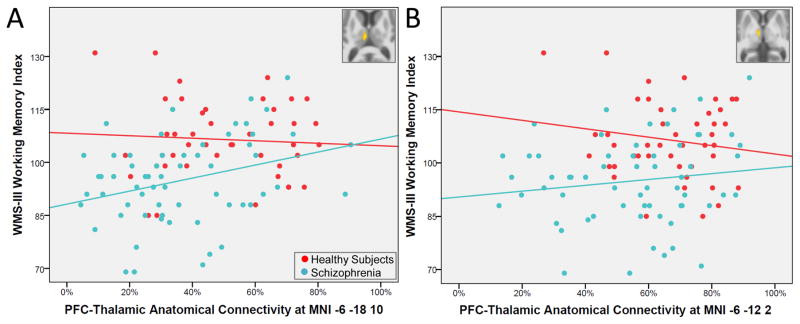
Results: Anatomical connectivity between the thalamus and PFC was reduced in schizophrenia. Voxelwise analysis localized the reduction to areas of the mediodorsal thalamus connected to lateral PFC. Reduced PFC-thalamic connectivity in schizophrenia correlated with impaired working memory but not cognitive flexibility and inhibition. In contrast to reduced PFC-thalamic connectivity, thalamic connectivity with somatosensory and occipital cortices was increased in schizophrenia.
Conclusions: The results are consistent with models implicating disrupted PFC-thalamic connectivity in the pathophysiology of schizophrenia and mechanisms of cognitive impairment. PFC-thalamic anatomical connectivity may be an important target for procognitive interventions. Further work is needed to determine the implications of increased thalamic connectivity with sensory cortex.
Keywords: Anatomical; Connectivity; Cortex; Diffusion; Schizophrenia; Thalamus.
Copyright © 2017 Society of Biological Psychiatry. Published by Elsevier Inc. All rights reserved.
Figures


Comment in
-
The Ups and Downs of Thalamocortical Connectivity in Schizophrenia.Biol Psychiatry. 2018 Mar 15;83(6):473-474. doi: 10.1016/j.biopsych.2018.01.005. Biol Psychiatry. 2018. PMID: 29429501 No abstract available.
References
-
- Miyake A, Friedman NP, Emerson MJ, Witzki AH, Howerter A, Wager TD. The unity and diversity of executive functions and their contributions to complex “Frontal Lobe” tasks: a latent variable analysis. Cogn Psychol. 2000;41:49–100. - PubMed
-
- Heinrichs RW, Zakzanis KK. Neurocognitive deficit in schizophrenia: a quantitative review of the evidence. Neuropsychology. 1998;12:426–445. - PubMed
-
- Palmer BW, Heaton RK, Paulsen JS, Kuck J, Braff D, Harris MJ, et al. Is it possible to be schizophrenic yet neuropsychologically normal? Neuropsychology. 1997;11:437–446. - PubMed
-
- Wilk CM, Gold JM, McMahon RP, Humber K, Iannone VN, Buchanan RW. No, it is not possible to be schizophrenic yet neuropsychologically normal. Neuropsychology. 2005;19:778–786. - PubMed
-
- Weickert TW, Goldberg TE, Gold JM, Bigelow LB, Egan MF, Weinberger DR. Cognitive impairments in patients with schizophrenia displaying preserved and compromised intellect. Arch Gen Psychiatry. 2000;57:907–913. - PubMed
Publication types
MeSH terms
Grants and funding
LinkOut - more resources
Full Text Sources
Other Literature Sources
Medical
Miscellaneous
