
Measles outbreaks raise 'difficult ethical question': Turn away unvaccinated patients?
Key takeaways:
- A debate over whether to accept unvaccinated patients into primary care practices has ramped up in the wake of a massive, deadly measles wave.
- “There are no right and wrong answers here,” an expert said.
Measles outbreaks in the United States have presented primary care providers with an ethical dilemma — how to balance a patient’s right to forgo vaccinations with the safety of other vulnerable patients who may be put at risk because of that choice.
Put simply: should PCPs accept patients who are not vaccinated with the measles, mumps and rubella vaccine during a measles outbreak? Ethically, is it better to accept all patients, no matter their vaccination status, but risk the health and safety of those who are immunocompromised or who have family members who are vulnerable to disease? Or should PCPs turn unvaccinated patients away, even with diminishing access to care in the United States?
“These are not straightforward, easy questions for the practitioner,” William Schaffner, MD, a professor of preventive medicine and infectious diseases at Vanderbilt University Medical Center and Healio | Infectious Disease News Editorial Board Member, told Healio. “Everyone can look at these issues and think about it for themselves. There are no right and wrong answers here. Everyone is going to have to decide how they deal with these ongoing — and, I think, increasing — circumstances in their practices.”
In 2025, there have been 607 confirmed cases of measles, according to data from the CDC, which was last updated on April 3. They were reported across 22 jurisdictions: Alaska, California, Colorado, Florida, Georgia, Kansas, Kentucky, Maryland, Michigan, Minnesota, New Jersey, New Mexico, New York, Ohio, Oklahoma, Pennsylvania, Rhode Island, Tennessee, Texas, Vermont and Washington. In just over 3 months, there have been six measles outbreaks — defined as three or more related cases. In 2024, there were 285 cases and 16 outbreaks.
Among this year’s confirmed cases, 97% were either unvaccinated or their vaccination status was unknown. Notably, 12% have been hospitalized and at least two unvaccinated children have died. An adult in New Mexico also tested positive for measles after their death, but the cause remains unconfirmed.
Schaffner said that with rampant vaccine hesitancy and skepticism, this “difficult ethical question” will become even more important for PCPs to consider.
“It is an issue that comes up in practices of pediatricians and family doctors principally, as well as sometimes in internal medicine practice where we take care of adults, so it's very common,” he said.
‘A preventable disease’
In 2000, measles was declared eliminated in the U.S., largely due to high vaccination rates, according to the CDC, but that status has been at risk.
When she was a medical student doing her rural family medicine rotation, Sarah Sams, MD, FAAFP, said the practice she was working at received a call from the closest ED. On the other end of the line, they suggested Sams go see their latest patient, who had measles, because “she’ll probably never see this ever again.”
“This was 30 years ago, and somebody was saying ‘you'll probably never see this again in your lifetime, so come look at this,’ and now we're worried about it because there are these big pockets of outbreaks, and 90% of those people who are getting outbreaks are not vaccinated,” Sams, a member of the American Academy of Family Physicians Board of Directors, told Healio. “We know that the vaccine works, and it’s among people who aren’t vaccinated that we’re seeing the illness and now death.”
Eric Ascher, DO, an osteopathic physician specializing in family and primary medicine at Northwell Lenox Hill Hospital, told Healio that he never expected to be discussing the importance of the measles vaccine, which is 97% effective and “has been around for more than 60 years,” but now he must, because it is being questioned for political reasons.
“Research shows there are limited side effects to the vaccine and it is created with safe ingredients. Smallpox has been eradicated because of vaccination. We saw a decrease in mortality during the COVID pandemic because of vaccination — similar to the flu,” he said. “While people have a right to question science and medicine, I fear for the future safety of our patients” when claims about vaccines come from “nonclinical individuals misguiding the population.”
“Even one death from measles is too many,” Ascher continued. “This is ... a preventable disease.”
The debate
Recently, The New England Journal of Medicine (NEJM) published a debate about a hypothetical 18-month-old child who had not received all vaccinations.
Ann Cheung, MD, a pediatric hospitalist at Massachusetts General Hospital and deputy editor for the NEJM, detailed the case, and offered two options: accept the patient or decline until they are vaccinated?
Sean T. O’Leary, MD, MPH, discussed the evidence around the first approach, and Jonathan L. Temte, MD, PhD, discussed the second. (NEJM editors assigned the experts to their respective approaches.)
“Refusing to care for a patient is a decision that no physician should make without careful consideration of the legal, moral and ethical implications,” O’Leary, a professor of pediatrics and infectious diseases at the University of Colorado’s Anschutz Medical Campus, wrote.
“Against the backdrop of measles, clinicians need to be deliberative and self-aware and adhere to ethical standards for duty to care, while simultaneously considering the health of the public, protection of vulnerable existing patients, severe consequences of measles, and reasonableness of vaccination,” according to Temte, a professor of family medicine and community health and associate dean for public health and community engagement at the University of Wisconsin School of Medicine and Public Health.
Side 1: Too risky to accept unvaccinated patients
Some people may be put at risk by others’ decisions to not be vaccinated.
For example, Schaffner said that, with “the miracles of modern medicine,” there is an increasing number of people who are immunocompromised due to illness but can live much more normal lives.
“Whether because of the nature of their illness or because they're receiving immunosuppressive medications, they can't take these vaccines. The question is, how do we protect them?” he continued. “We protect them by having everyone else around them well vaccinated, providing what's been called ‘a cocoon of protection.’”
If an unvaccinated child who has developed measles is in a waiting room with others, they could expose these patients — “some of whom may have a medical exemption, some of whom may be too young yet to get vaccinated” — to an extreme danger, Schaffner said.
So, some practices do not accept new patients who are unvaccinated.
For practices with this mindset, the typical approach is a policy that says the practice will provide vaccines according to the recommended schedule. Therefore, any new parent wishing to enroll their child in that practice would need to abide by these rules.
“In other words, ‘We're going to have this conversation on the front end. We're not going to have this conversation every time a child comes into our practice,’” Schaffner said. “There are any number of practices that have that discussion on the front end.”
Currently, about half of pediatric practices in the U.S. follow this policy, O’Leary wrote.
But what about patients already enrolled in the practice who then opt out of vaccinations?
“Dr. Tempte says this does not apply to children and the parents who already are in the practice,” Schaffner said. “It may be that the parents have a second child, and they've had second thoughts now. They've been on social media and they have a lot of questions that they didn't have when the first child was growing up, but they do now. And John makes the point that we don't discharge patients from our practice; those patients, we’ll have to cope with on an individual basis.”
Those who hold this view are typically concerned with protecting the most vulnerable in our society, which Schaffner emphasized.
As more parents withhold vaccinations, “that cocoon of protection develops holes and gaps such that if the measles virus — or other vaccine preventable disease — is introduced into that community, it puts these immunocompromised persons at risk,” he said.
“Should they become infected, they surely will get quite severe disease,” he said. “And I am unabashed and straightforward in saying we have a responsibility not only to protect our own children, but to contribute to the protection of those frail brothers and sisters who live among us.”
Ascher agreed that “vaccinations are more than protection of the individual being vaccinated.”
“They are about protection of your community as well,” he said. “There are some who do not meet age criteria for vaccination. You are placing those individuals at risk by not being vaccinated.”
However, not accepting a patient is never an easy decision.
Schaffner said a major issue to consider is that when declining a child medical care, their parents will obviously have to seek it elsewhere. There is currently a massive work force shortage in primary care; it is estimated that, as a whole, the U.S. has less than half of the PCPs its citizens need and about 99 million people are in a primary care professional shortage area.
“There may be physicians in the community who are more compliant with the parents’ wishes, but as we become more rural and there are limitations as to where parents can find such physicians, that becomes a much more difficult decision,” he said.
Side 2: Acceptance and persistence
Although she understands the choice to refuse new unvaccinated patients, Sams said she has a different outlook.
“I have always taken a different philosophy that those are probably the patients I need to see the most because they are the ones that I need to continue to have those conversations with in a nonjudgmental, supportive way,” Sams said. “I think, when they are turned away from health care providers because of that, it just sort of reinforces some of the division between the medical community and them. Also, the child then misses a lot of other well care, unless they find somebody else who will see them. And it misses some opportunities for education.”
Sams said there are still ways PCPs accepting these new patients can work to protect their other vulnerable patients.
For example, in a traditional set-up, PCPs have large waiting rooms where everyone is in the same general area. As infected patients could be contagious but asymptomatic, “you do have to worry about potential exposures for people who will come in for maybe a well visit or something,” Sams said.
In this case, Sams said separate entrances and waiting rooms for symptomatic patients are good options for facilities that can accommodate them. She also said her practice asks any patients showing respiratory symptoms to mask in all common areas.
But the most valuable way Sams said she can help is by engaging with vaccine-hesitant patients.
“I think as we continue to educate and not turn them away but actually continue to provide that education, that resource — they may not say yes today, but they may hear more stories of children dying and choose to come back in and get that done,” Sams said. “If you haven't turned them away from your office, they're more likely to come back to you and say, ‘Hey, you know what? I changed my mind.’”
Educating hesitant patients
Sams shared several stories of families who initially chose to not vaccinate their children but changed their minds over time. In some cases, she said, there was a seemingly sudden breakthrough in the continued discussions. In others, parents came in after hearing of the recent outbreaks and decided the benefits outweighed the risks.
One case that sticks out to Sams was a child who had listened to Sams’s discussions with her parents throughout her childhood and decided to fully vaccinate herself later on.
“I took care of this kid for her entire life, and at 18 years old, she said, ‘Now I'm an adult, I can decide for myself; please start vaccinating me,’ because she had heard me have those conversations with her parents over and over and I continued to have those conversations despite the fact that they had said no,” Sams said.
To have an effective conversation, it is important for PCPs to be updated on current talking points, Ascher said, because “there is a lot of misinformation to sift through.”
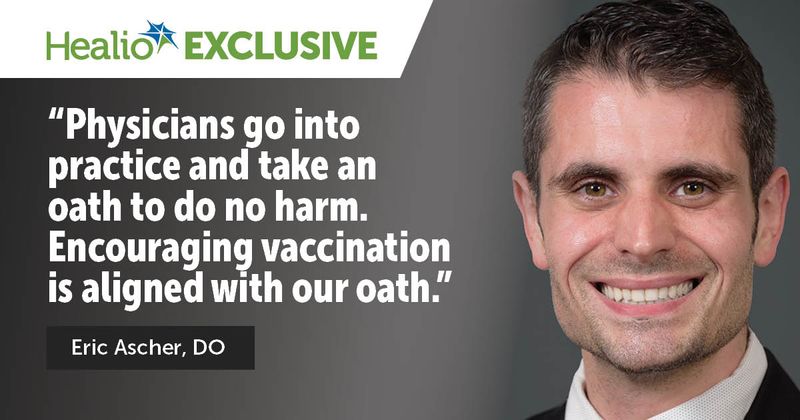
“With social media at the consistent fingertips of the population, anyone with a platform has the opportunity to share their opinions, whether appropriately backed by fact or not,” he said. “Physicians go into practice and take an oath to do no harm. Encouraging vaccination is aligned with our oath.”
When he has these discussions, Ascher said that asking parents or patients why they are hesitant to receive a vaccine “is a wonderful way to open up the conversation.”
“Usually, the parent would say something along the lines of ‘my neighbor/friend said’ or ‘I read on Facebook,’” he said. “I remind the parent that as a health care provider, I took an oath to do no harm. That I firmly believe in preventative medicine, and anything we can do to prevent a disease that has limited consequences is oftentimes worth it. I ask what myths they have heard and dispel them. I offer facts backed by science and share what I recommend my own family does.
“Patients still will look up to your recommendations and consider them,” Ascher continued. “Every vaccination that prevents disease will have a ripple effect. Keep up the good work, exhausting as it may be, as belittling as it may be. You are truly making a difference.”
For more on measles, check out Healio’s Clinical Guidance module here.
For more information:
Eric Ascher, DO, Sarah Sams, MD, FAAFP, and William Schaffner, MD, can be reached at primarycare@healio.com.
Perspective
Back to Top
As a nurse practitioner student, I had the privilege of being partnered with an exceptional pediatric provider. Going into the rotation I had some ideas and ideals that were very much influenced by my role as mom to four children. I didn’t want to care for kids whose parents had refused vaccines or wanted an alternative immunization schedule. My reasons were that I didn’t want to risk exposing other kids in a waiting room or my own to illness.
I was reminded that without a relationship, it’s hard to change one’s perspective on anything. Without an established rapport, why should someone trust or listen to a physician, NP or anyone in public health? Sure, someone may have training and a license, but did the one making recommendations care for their kid?
The research done on this topic shows that individuals do trust their providers more than they trust other voices. People are willing to have conversations, raise concerns, ask questions and think through their decisions with someone committed to their care. And, because they work, I can trust that I and others who are up to date on vaccines are protected from severe disease.
I ultimately decided to work on establishing healthy relationships with patients and their family members, including embracing shared decision-making and creating a safe space for questions and concerns. I learned to prepare parents for vaccine side effects like a low-grade temperature, fussiness or redness and swelling at the site. I made myself available for phone calls after visits in case additional questions or concerns came up. I keep getting my kids vaccinated on schedule, get my own shots, wear a mask for anything potentially contagious, and always wash my hands.
Parents who question vaccines are asking us to do our jobs. We should be prepared to listen, explain anything we recommend and be patient as people make decisions. Ultimately, we want to model a healthy relationship for the kids watching. The goal is that children will transition to managing their own care and feel comfortable engaging their provider in a host of questions and bringing up real concerns without feeling judged. If a parent or patient recognizes that a continuous recommendation for vaccines is not compatible with their choice, they may decide to seek care elsewhere. They’ll be welcome by me to stay.
References:
McKee M, et al. Isr J Health Policy Res. 2024;doi:10.1186/s13584-024-00611-1.
New poll: Trump voters want COVID vaccine information from doctors, not politicians. https://debeaumont.org/news/2021/new-poll-trump-voters-want-covid-vaccine-information-from-doctors-not-politicians/. Published March 5, 2021. Accessed Dec. 22, 2025.
Sources/Disclosures
Source:
Healio Interviews
References:
- CDC. History of measles. https://www.cdc.gov/measles/about/history.html#cdc_generic_section_3-measles-elimination-in-the-united-states. Accessed March 31, 2025.
- CDC. Measles cases and outbreaks. https://www.cdc.gov/measles/data-research/index.html#cdc_data_surveillance_section_10-measles-cases-in-2025. Last updated April 3, 2025. Accessed March 31, 2025.
- Cheung A, et al. N Engl J Med. 2025;doi:10.1056/NEJMclde2407983.
- Clinical guidance: Measles. https://www.healio.com/clinical-guidance/measles. Accessed March 31, 2025.
Disclosures: Ascher, Sams and Schaffner report no relevant financial disclosures.

Ask a clinical question and tap into Healio AI's knowledge base.
- PubMed, enrolling/recruiting trials, guidelines
- Clinical Guidance, Healio CME, FDA news
- Healio's exclusive daily news coverage of clinical data
Read more about