. 2018 Aug 7;26(8):1116-1126.e4.
doi: 10.1016/j.str.2018.05.015. Epub 2018 Jul 5.

Engineering of a Polydisperse Small Heat-Shock Protein Reveals Conserved Motifs of Oligomer Plasticity

Affiliations

Engineering of a Polydisperse Small Heat-Shock Protein Reveals Conserved Motifs of Oligomer Plasticity

Sanjay Mishra et al. Structure. .

Abstract

Small heat-shock proteins (sHSPs) are molecular chaperones that bind partially and globally unfolded states of their client proteins. Previously, we discovered that the archaeal Hsp16.5, which forms ordered and symmetric 24-subunit oligomers, can be engineered to transition to an ordered and symmetric 48-subunit oligomer by insertion of a peptide from human HspB1 (Hsp27). Here, we uncovered the existence of an array of oligomeric states (30-38 subunits) that can be populated as a consequence of altering the sequence and length of the inserted peptide. Polydisperse Hsp16.5 oligomers displayed higher affinity to a model client protein consistent with a general mechanism for recognition and binding that involves increased access of the hydrophobic N-terminal region. Our findings, which integrate structural and functional analyses from evolutionarily distant sHSPs, support a model wherein the modular architecture of these proteins encodes motifs of oligomer polydispersity, dissociation, and expansion to achieve functional diversity and regulation.

Keywords: Hsp27; chaperones; electron microscopy; multi-angle light scattering; native state mass spectrometry; proteostasis; sHSP; small heat-shock protein.


Conflict of interest statement

Declaration of Interests

The authors declare no competing interests.

Figures
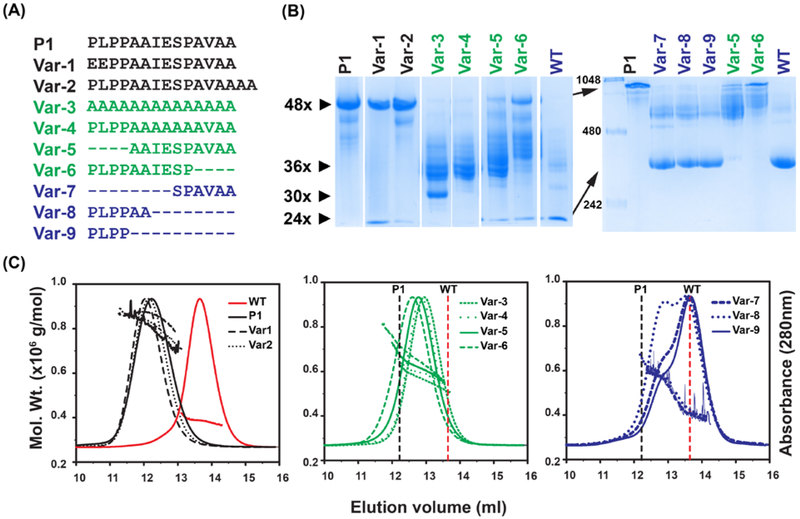
Figure 1.
Figure 1.. Characterization of the oligomers formed by insertion of peptides in Hsp16.5.
A, Sequences of the peptides inserted in the Hsp16.5 sequence between residues 33-34. The variants are grouped by color according to oligomeric properties shown in panels B and C. B, BN-PAGE. Left panel, 5% acrylamide gel; right panel, 7.5% acrylamide gel (STAR Methods). The approximate number of subunits corresponding to band mobility is shown with small arrows on the left side of the left panel. The molecular weight marker is shown in the first lane of the right panel. Large arrows highlight mobility differences of the P1-insert and WT constructs in the 7.5% acrylamide gel. Lanes have been rearranged according to variants after documenting the gels. C, SEC-MALS analysis of purified variants. Variants are grouped according to similar characteristics. The molecular mass range that is sampled across the elution peak is indicated by the slope of the line for each variant. The vertical lines benchmark the WT (dotted red) and the P1-insert (dotted black) elution peak. (See also Figure S2 and Table S2)
Figure 2.
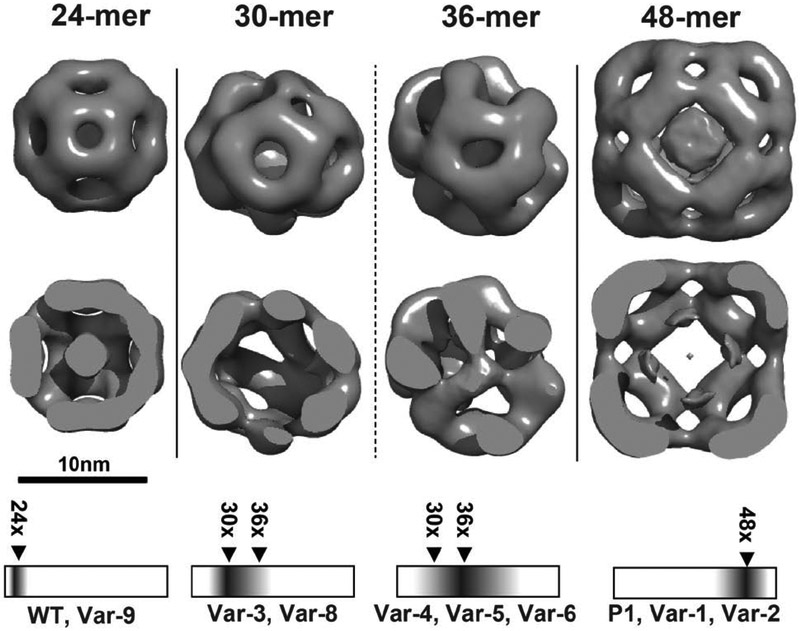
Figure 2.. Three dimensional negative stain-EM reconstructions of representative oligomers from peptide insertion variants of Hsp16.5:
24-subunit (WT-like), 30-subunit, 36-subunit, and 48-subunit (P1-like). The top panel shows a surface representation and the middle panel is a clipped view revealing internal structure. Unlike the 36-subunit oligomer, the internal anatomy of the intermediate 30 subunit class structure lacks density. However, the circumference for these two types of particles is similar. In contrast to the well-ordered arrangement of the 24- and 48-subunit oligomers, the intermediate size oligomers demonstrate enhanced heterogeneity and lack of symmetry. The relative particle distribution for each variant is given in Table 1. The bottom panel correlates the EM analysis with the BN-PAGE results (in cartoon representation) of the oligomer distribution and identifies the predominant species for P1 variants. (See also Figure S3)
Figure 3.
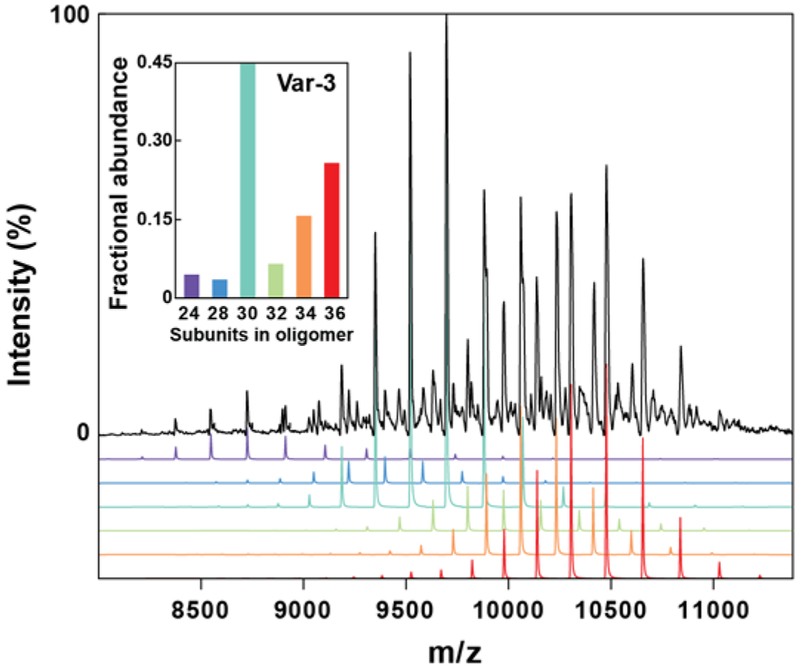
Figure 3.. Oligomer binning of Var-3 by native state mass spectrometry.
Native mass spectrum of Var-3 revealed the co-population of multiple oligomeric states. The relative abundances of the different states (inset) were extracted from the signal intensity. (See also Table S3)
Figure 4.
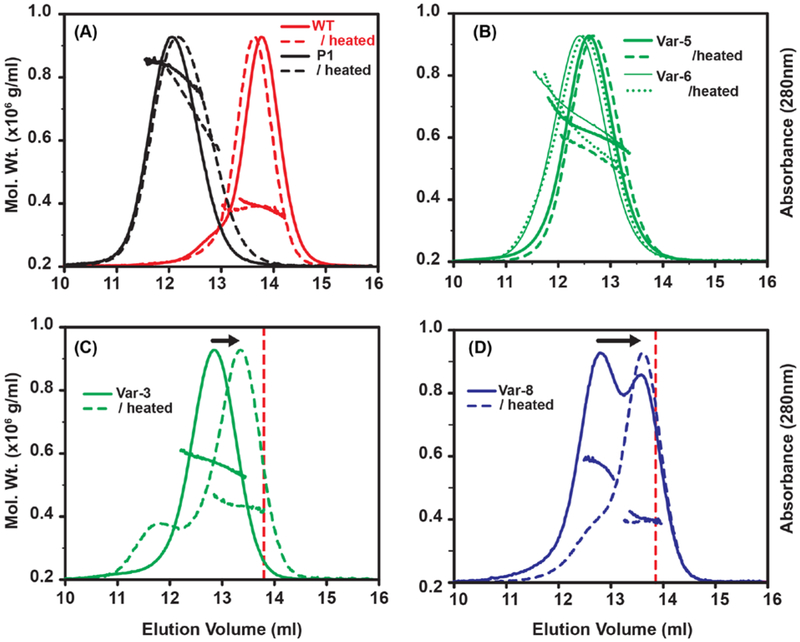
Figure 4.. Temperature-induced oligomer rearrangement in Hsp16.5 variants.
Variants were analyzed by SEC-MALS before (continuous line) and after incubation at 68 °C for 30 min (dashed line). A-B, the 24-subunit WT, the 48-subunit P1-insert, and the intermediate-size Var-5 and Var-6 oligomers were not susceptible to temperature-induced structural rearrangement. C, In contrast, Var-3 oligomers reassembled as a smaller oligomer upon heat treatment. D, incubation of Var-8 induced an increase of the WT-like 24-subunit arrangement and a reduction of the intermediate-size oligomer. The dotted vertical lines in C and D benchmark the WT 24-subunit elution peak.
Figure 5.
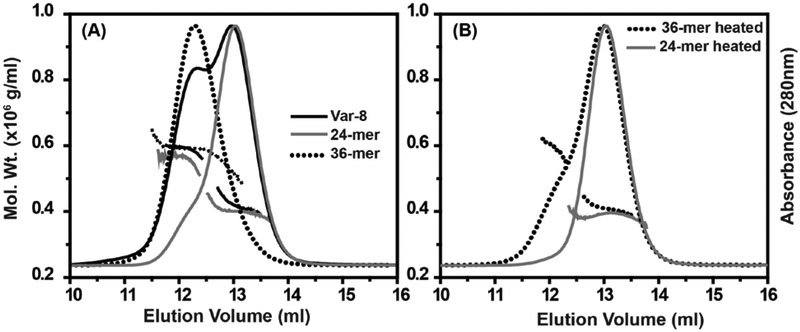
Figure 5.. Isolation, characterization, and rearrangement of Var-8 oligomer subpopulations.
A, 24- (gray trace) and 36-subunit (dotted trace) oligomers of Var-8 demonstrated similar MALS size distribution properties as the equilibrium populations observed prior to isolation by SEC. B, Incubation of the isolated 36-subunit oligomer (dotted trace) at 68 °C for 30 min induced collapse of the oligomer to a more thermostable 24-subunit arrangement (gray trace). (See also Figure S8)
Figure 6.
Figure 6.. Temperature-induced subunit-rearrangement in Hsp16.5-P1 variants.
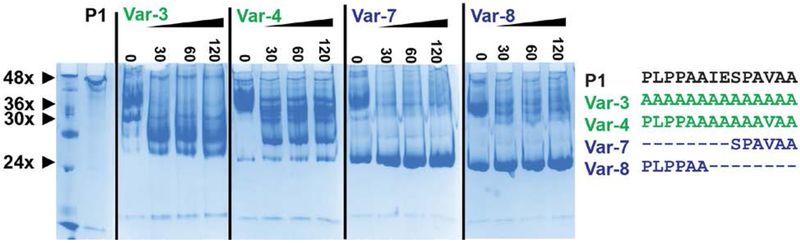
30μg proteins were incubated at 68° C for 0, 30, 60, and 120 min, and were resolved at pH 7.0 on 7.5% blue native polyacrylamide gels.
Figure 7.
Figure 7.. Binding isotherms of selected Hsp16.5 variants to bimane-labeled T4L-L99A.
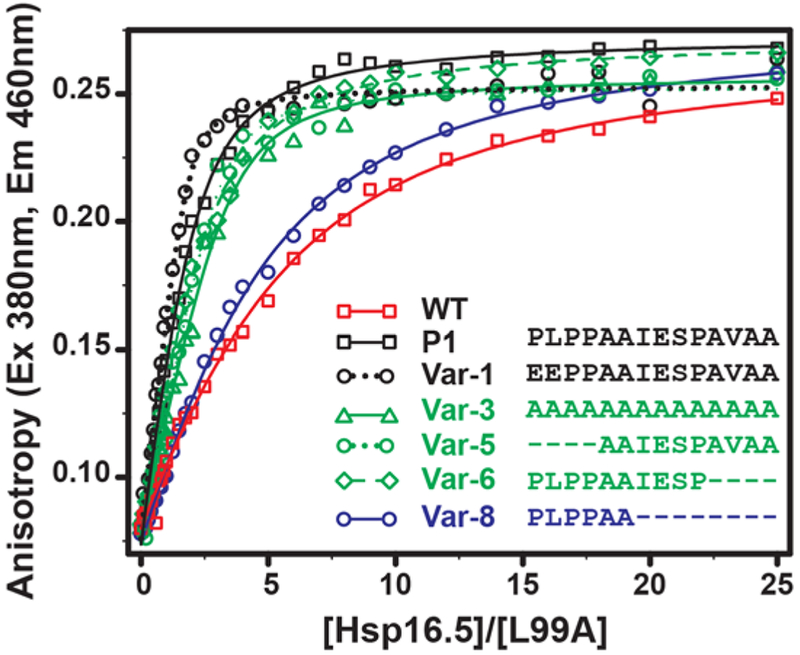
An increase in binding affinity correlates with variants that form large oligomers relative to WT. T4L (5μM) was incubated with increasing molar concentrations (X-axis) of sHSP variants for 2hrs at 37 °C in pH 7.2 buffer, and the fluorescence anisotropy (Y-axis) of the labeled substrate T4L-L99A was measured. The solid lines are non-linear least-squares fits to a single-mode binding model. The KD for each variant is reported in Table S4.
Figure 8.
Figure 8.. Impact of the PLPP motif on the assembly of Hsp27* oligomers and client protein binding.
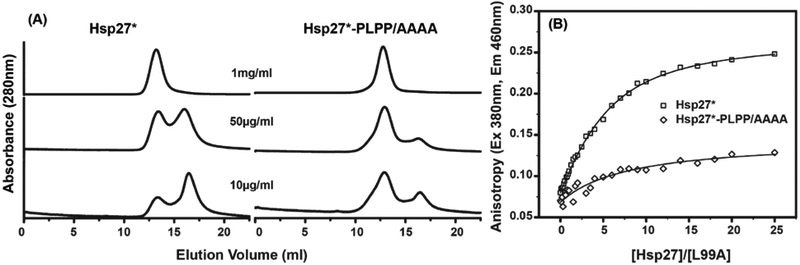
A, Concentration-dependent dissociation of the Hsp27* oligomer into the functionally-active dimer is disrupted when the PLPP sequence is substituted with a tetra-alanine peptide. 100μl of the proteins, at the indicated concentrations, were eluted at room temperature from the SEC column at pH 7.2. B, Binding to bimane-labeled T4L-L99A is highly attenuated for Hsp27*-PLPP/AAAA mutant, which correlates with reduced propensity to form the dimeric species. T4L-L99A (5μM) was incubated with increasing molar excess of Hsp27* (X-axis) for 2hrs at 37 °C in pH 7.2 buffer, and the fluorescence anisotropy (Y-axis) of the labeled substrate T4L-L99A was measured. (See also Figure S7)

References

    1. Andley UP (2007). Crystallins in the eye: Function and pathology. Progress in Retinal and Eye Research 26, 78–98. - PubMed
    1. Andley UP, Hamilton PD, Ravi N, and Weihl CC (2011). A Knock-In Mouse Model for the R120G Mutation of αB-Crystallin Recapitulates Human Hereditary Myopathy and Cataracts. PLoS ONE 6, e17671. - PMC - PubMed
    1. Aquilina JA, Benesch JL, Bateman OA, Slingsby C, and Robinson CV (2003). Polydispersity of a mammalian chaperone: mass spectrometry reveals the population of oligomers in alphaB-crystallin. Proc Natl Acad Sci U S A 100, 10611–10616. - PMC - PubMed
    1. Basha E, O'Neill H, and Vierling E (2012). Small heat shock proteins and α-crystallins: dynamic proteins with flexible functions. Trends Biochem Sci 37, 106–117. - PMC - PubMed
    1. Benesch JL, Aquilina JA, Ruotolo BT, Sobott F, and Robinson CV (2006). Tandem mass spectrometry reveals the quaternary organization of macromolecular assemblies. Chem Biol 13, 597–605. - PubMed

Publication types

MeSH terms