. 2021 May:97:57-65.e5.
doi: 10.1016/j.exphem.2021.02.008. Epub 2021 Feb 19.

The delta isoform of phosphatidylinositol-3-kinase predominates in chronic myelomonocytic leukemia and can be targeted effectively with umbralisib and ruxolitinib

Affiliations

The delta isoform of phosphatidylinositol-3-kinase predominates in chronic myelomonocytic leukemia and can be targeted effectively with umbralisib and ruxolitinib

Matthew T Villaume et al. Exp Hematol. 2021 May.

Abstract

Chronic myelomonocytic leukemia (CMML) is a myelodysplastic syndrome/myeloproliferative neoplasm overlap syndrome characterized by monocytic proliferation in the presence of dysplastic bone marrow changes, inflammatory symptoms, and propensity for transformation to acute myeloid leukemia (AML), with a poor prognosis and limited treatment options. Unlike the α and β isoforms, the phosphatidylinositol-3-kinase (PI3K)-δ signaling protein is predominantly expressed by hematopoietic cells and therefore has garnered interest as a potential target for the treatment of lymphomas and leukemias. We revealed a pattern of increased PIK3CD:PIK3CA ratio in monocytic M5 AML patients and cell lines, and this ratio correlated with responsiveness to pharmacological PI3K-δ inhibition in vitro. Because CMML is a disease defined by monocytic clonal proliferation, we tested the PI3K-δ inhibitor umbralisib as a single agent and in combination with the JAK1/2 inhibitor ruxolitinib, in CMML. Our ex vivo experiments with primary CMML patient samples revealed synergistic inhibition of viability and clonogenicity with this combination. Phospho-specific flow cytometry revealed that dual inhibition had the unique ability to decrease STAT5, ERK, AKT, and S6 phosphorylation simultaneously, which offers a mechanistic hypothesis for the enhanced efficacy of the combination treatment. These preclinical data indicate promising activity by co-inhibition of PI3K-δ and JAK1/2 and support the use of ruxolitinib + umbralisib combination therapy in CMML under active clinical investigation.


Conflict of interest statement

Conflict of interest disclosure MRS receives research funding from Astex, Incyte, Millennium, and TG Therapeutics; serves on consultancy/advisory board/monitoring committees for AbbVie, Astex, BMS, Celgene, Geron, Karyopharm, Millennium, Ryvu, Sunesis, and TG Therapeutics; has equity in Karyopharm; and has patents and royalties with Boehringer-Ingelheim. The remaining authors have no competing financial interests.

Figures
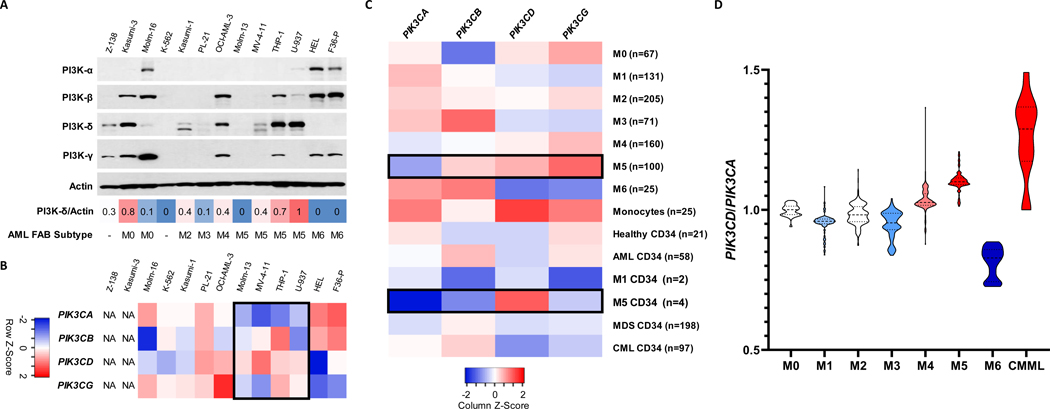
Figure 1.
Figure 1.. PI3K catalytic subunit expression patterns in myeloid leukemias.
(A) Western blot analysis of 11 myeloid and 1 lymphoid neoplasm cell lines to determine protein levels of PI3K-δ. Actin was used as a loading control. PI3K-δ/Actin ratio describes relative density of western blot band as measured by Image Studio Lite ver 5.2. French-American-British (FAB) subtyping differentiates AML by cell maturity and origin based on histological evaluation. (B) Heatmap of the microarray median gene expression of PI3K catalytic subunit genes in available cell lines in the CCLE. NA = not available (C) Heatmap of the median gene expression for each AML FAB class, healthy samples, healthy monocytes, and CD34+ cells from AML, MDS, CML and healthy donor samples in the Hemap dataset. (D) Violin plot of PIK3CD to PIK3CA median log2 gene expression ratio by AML FAB subtype from Hemap data set. CMML data gathered from Gelsi-Boyer et al.
Figure 2.
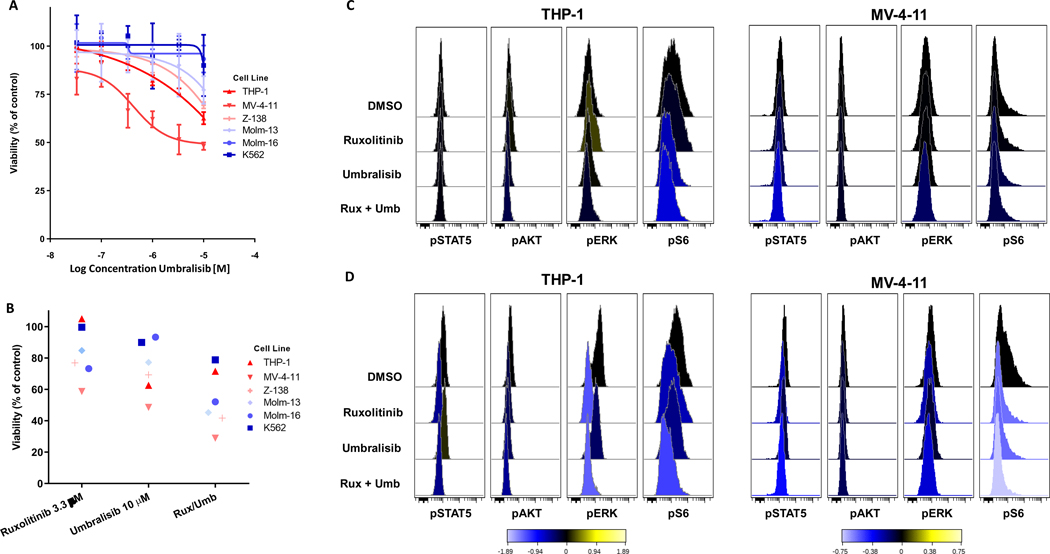
Figure 2.. Ruxolitinib/umbralisib combination treatment of leukemia cell lines.
(A-B) The viability of treated cell lines compared with DMSO control using the CellTiter-Glo assay was plotted for (A) the indicated concentration gradient of solo agent umbralisib and (B) at selected concentrations of both ruxolitinib, umbralisib and the combination. Each symbol represents the mean of three experimental replicates. The color associated with each cell line relates to the relative expression of PI3K-δ as determined by western blot analysis. (C-D) Histograms from a representative experimental replicate (n = 2) of phospho-specific flow cytometry analysis of cell signaling responses of THP-1 and MV-4–11 cell lines to the combination treatment in the absence (C) or presence (D) of GM-CSF stimulation. Values represent arcsinh of the median fold change from DMSO treated cells.
Figure 3.
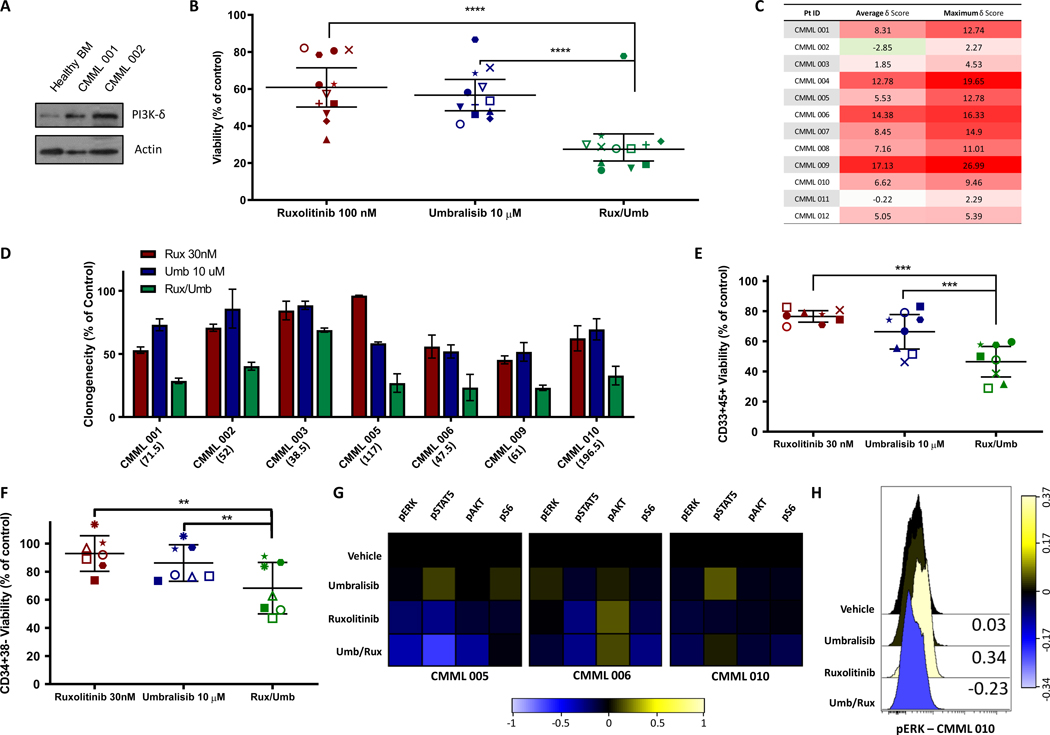
Figure 3.. Ruxolitinib/Umbralisib combination ex vivo treatment of CMML patient samples.
(A) Western blot analysis of 2 CMML patient bone marrow samples and 1 healthy bone marrow sample. Actin was used as a loading control. (B) The viability of treated cells compared with DMSO control using the CellTiter-Glo assay was plotted for the indicated concentrations. Individual patients are represented by specific shapes. (two-tailed t-test; n.s. not significant, *p < 0.05, **p <0 .01, ***p<0.005, ****p<0.001) (C) The overall ZIP δ synergy score was based on the entire range of doses tested, and the most synergistic area score was based on the specific concentrations that had the highest synergy for each CMML sample tested. Red shading indicates increasing synergy values. (D) Inhibitory effect of ruxolitinib (Rux), umbralisib (Umb) and the combination (Rux/Umb) on CFU-GM growth from CMML samples stimulated with GM-CSF. Colony growth was assessed after 14 d. Results are expressed as % CFU-GM growth relative to cultures without drug. Multiple regression analysis confirmed that the combination treatment reduced clonogenicity by more than either individual drug treatment (ps < 0.001). Parenthetical below horizontal labels represents the average number of colonies counted in each experiments respective control condition. (E-F) Viability was determined by Annexin V/DAPI staining using flow cytometry with viable cell defined as AnnexinVDAPI for both early myeloid (CD45+/CD33+) at 24 hours and hematopoietic stem cells (CD34+CD38) at 48 hours. Each symbol represents a single experimental replicate for each patient sample. (G) Heatmap showing phosphorylated signaling protein changes measured using phospho-specific flow cytometry. Samples were incubated with DMSO, umbralisib, ruxolitinib, or the combination for 30 minutes and subsequently incubated with GM-CSF for 15 minutes before fixing and staining. Color shading represents arcsinh values of the median fold change from DMSO treated cells. (H) Histograms of pERK protein levels in unstimulated culture conditions (without addition of GM-CSF) in response to ruxolitinib, umbralisib or their combination in a single NRAS-mutant patient sample. Values represent arcsinh of the median fold change from DMSO treated cells.

References

    1. Itzykson R, Kosmider O, Renneville A, et al. Prognostic score including gene mutations in chronic Myelomonocytic Leukemia. J Clin Oncol. 2013;31(19):2428–2436. doi: 10.1200/JCO.2012.47.3314 - DOI - PubMed
    1. Padron E, Painter JS, Kunigal S, et al. GM-CSF-dependent pSTAT5 sensitivity is a feature with therapeutic potential in chronic myelomonocytic leukemia. Blood. 2013;121(25):5068–5077. doi: 10.1182/blood-2012-10-460170 - DOI - PMC - PubMed
    1. Padron E, Dezern A, Andrade-Campos M, et al. A multi-institution phase I trial of ruxolitinib in patients with chronic myelomonocytic leukemia (CMML). Clin Cancer Res. 2016;22(15):3746–3754. doi: 10.1158/1078-0432.CCR-15-2781 - DOI - PMC - PubMed
    1. Geissler K, Ohler L, Födinger M, et al. Interleukin 10 inhibits growth and granulocyte/macrophage colony-stimulating factor production in chronic myelomonocytic leukemia cells. J Exp Med. 1996;184(4):1377–1384. doi: 10.1084/JEM.184.4.1377 - DOI - PMC - PubMed
    1. Britschgi A, Andraos R, Brinkhaus H, et al. JAK2/STAT5 Inhibition Circumvents Resistance to PI3K/mTOR Blockade: A Rationale for Cotargeting These Pathways in Metastatic Breast Cancer. Cancer Cell. 2012;22(6):796–811. doi: 10.1016/J.CCR.2012.10.023 - DOI - PubMed

Publication types

MeSH terms