. 2019 Aug 10:11:100190.
doi: 10.1016/j.ynstr.2019.100190. eCollection 2019 Nov.

Cyclooxygenase-2 inhibition reduces anxiety-like behavior and normalizes enhanced amygdala glutamatergic transmission following chronic oral corticosterone treatment

Affiliations

Cyclooxygenase-2 inhibition reduces anxiety-like behavior and normalizes enhanced amygdala glutamatergic transmission following chronic oral corticosterone treatment

Amanda Morgan et al. Neurobiol Stress. .

Abstract

Chronic stress increases the probability of receiving an anxiety, depression, or chronic illness diagnosis. Pharmacological interventions that reduce the behavioral and physiological effects of chronic stress in animal models may represent novel approaches for the treatment of stress-related psychiatric disorders. Here, we examined the effects of cyclooxygenase-2 (COX-2) inhibition on anxiety-like behaviors and amygdala glutamatergic signaling after chronic non-invasive oral corticosterone (CORT) administration in mice. Treatment with the highly selective COX-2 inhibitor Lumiracoxib (LMX) reversed anxiety-like behavior induced by chronic CORT. Specifically, acute and repeated administration of LMX 5 mg kg-1 reduced chronic CORT-induced anxiety-like behavior measured using the elevated-plus maze, elevated-zero maze, and light-dark box tests. In contrast, LMX did not affect anxiety-like behaviors in naïve mice. Ex vivo electrophysiology studies revealed that repeated LMX treatment normalized chronic CORT-induced increases in spontaneous excitatory glutamatergic currents recorded from anterior, but not posterior, basolateral amygdala neurons. These data indicate COX-2 inhibition can reverse chronic CORT-induced increases in anxiety-like behaviors and amygdala glutamatergic signaling, and support further clinical investigation of selective COX-2 inhibitors for the treatment of affective and stress-related psychiatric disorders.

Keywords: Anxiety; Basolateral amygdala; Cyclooxygenase-2; Stress.


Figures
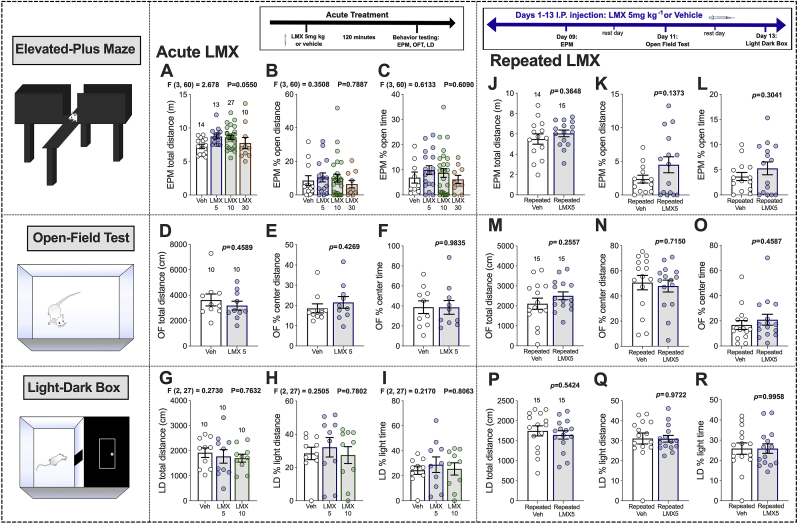
Fig. 1
Fig. 1
Effects of acute and repeated LMX on anxiety-like behavior in naïve mice. Effects of acute LMX (5, 10, and 30 mg kg−1) in EPM (A–C). Effects of acute LMX (5 mg kg−1) in the OFT (D–F). Effects of LMX (5 and 10 mg kg−1) in the LD Box (G–I). Effects of repeated LMX (5 mg kg−1) in the EPM (J–L) OFT (M–O) LD Box (P–R). Data presented as mean ± SEM with individual data points representing one mouse (n; noted above bar graphs). F and p-values for one-way ANOVA or p-values for unpaired t-test shown in individual panels.
Fig. 2
Fig. 2
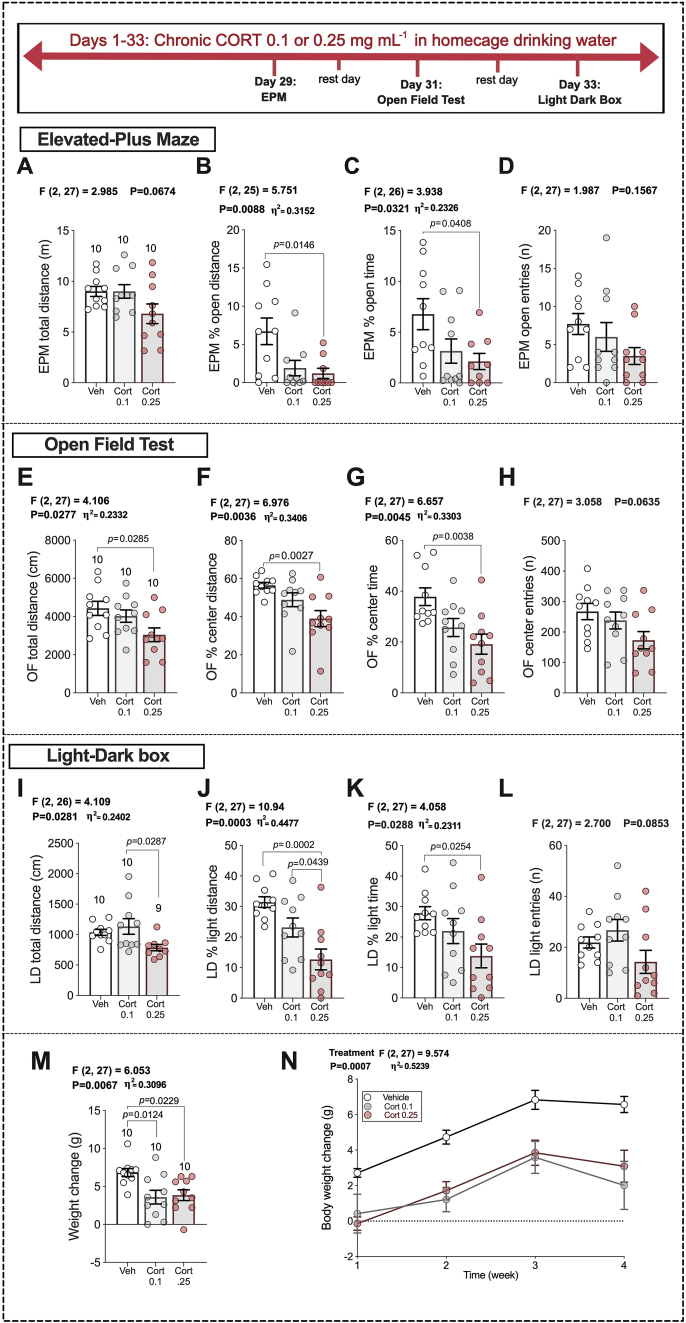
Chronic oral corticosterone increases anxiety-like behavior. Vehicle (1% EtoH), 0.1 or 0.25 mg/mL corticosterone, administered in homecage drinking water for 33 days. EPM results: (A–D). OFT results: (E–H). LD box: (I–L). The number of mice per group are included on the first graph for each measure (far left of each row). p-values (above bars) represent significance levels of Holm-Sidak pairwise comparisons between individual groups after Omnibus ANOVA (ANOVA F-scores above graphs). Data presented as individual values, with Mean ± SEM. Effect sizes depicted as η2 and shown for significant main effects.
Fig. 3
Fig. 3
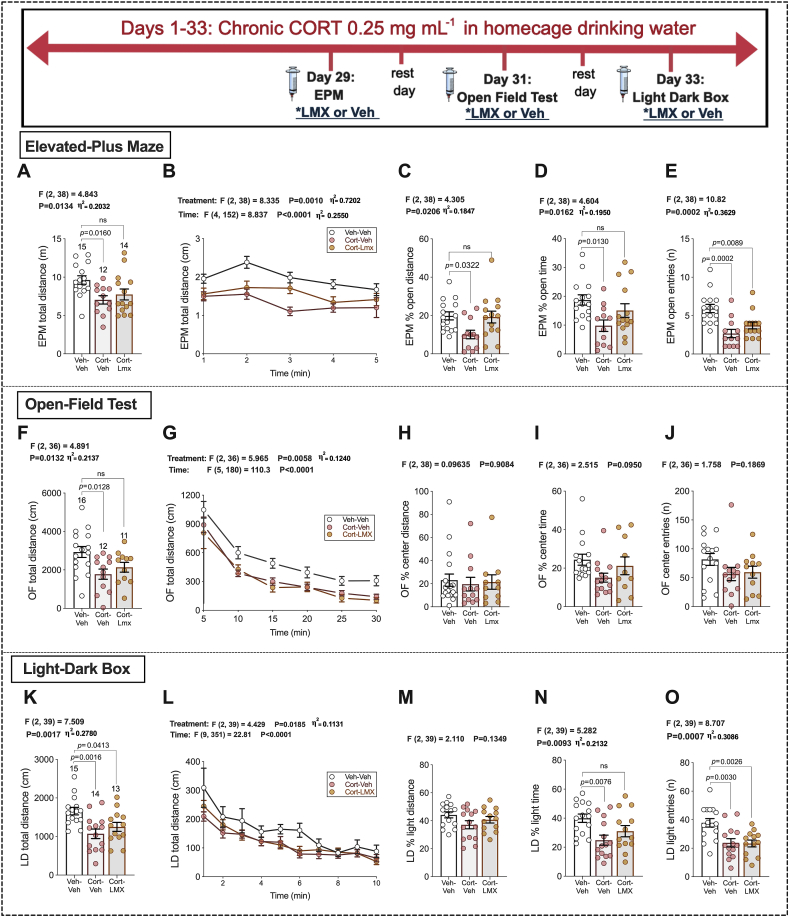
Acute COX-2 inhibition following high-dose chronic CORT in homecage drinking water. Vehicle water (1% EtoH) or 0.25 mg/mL CORT, administered in homecage for 33 days. EPM results (A–E), OFT (F–J), LD (K–O). The number of mice per group are included on the first graph for each measure (far left of each row). p-values (above bars) represent significance levels of Holm-Sidak pairwise comparisons between individual groups after Omnibus ANOVA (F-scores above graphs). Data graphs B, G, & L were analyzed with Two-Way ANOVA. Data points represent individual values, with Mean ± SEM. Data presented as individual values, with Mean ± SEM. Effect sizes depicted as η2 and shown for significant main effects.
Fig. 4
Fig. 4
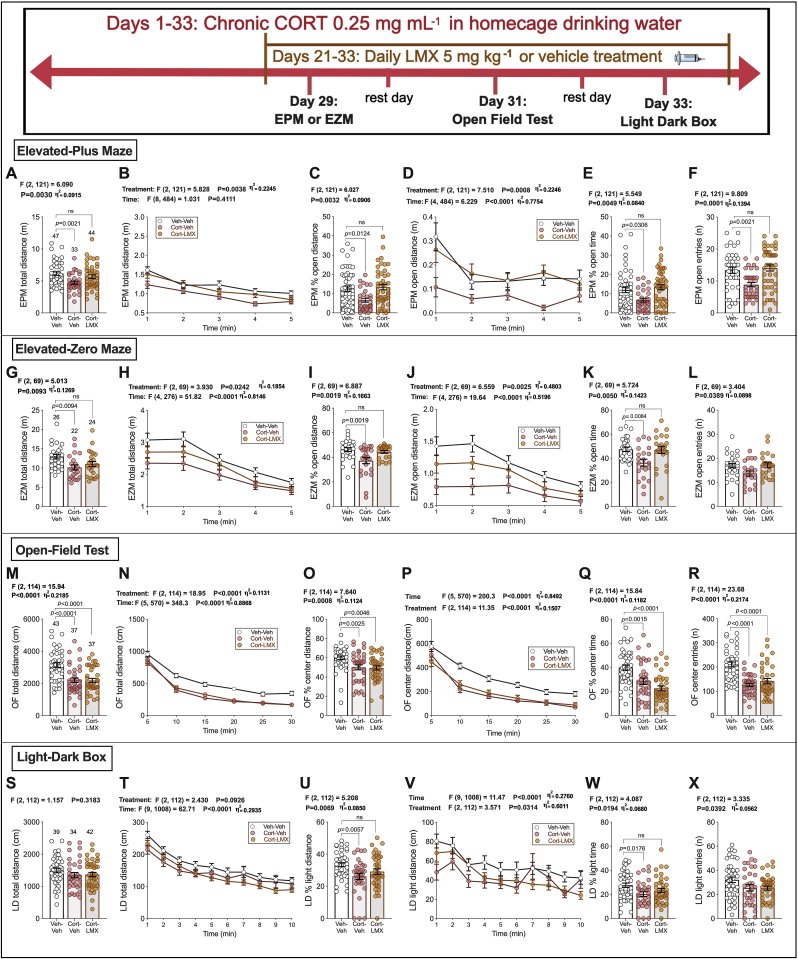
Repeated, Subchronic COX-2 inhibition following high-dose chronic CORT in homecage drinking water. Vehicle water (1% EtoH) or 0.25 mg/mL CORT, administered in homecage for 33 days. EPM results: (A–F). EZM: (G–L) OFT results: (M–R) LD box: (S–X). p-values (above bars) as indicated from Holm-Sidak pairwise comparisons after two-way ANOVA (below graphs B, D, H, J, N, P, T, V) or Omnibus ANOVA (remaining graphs). Data presented as individual values, with Mean ± SEM. Effect sizes depicted as η2 and shown for significant main effects.
Fig. 5
Fig. 5
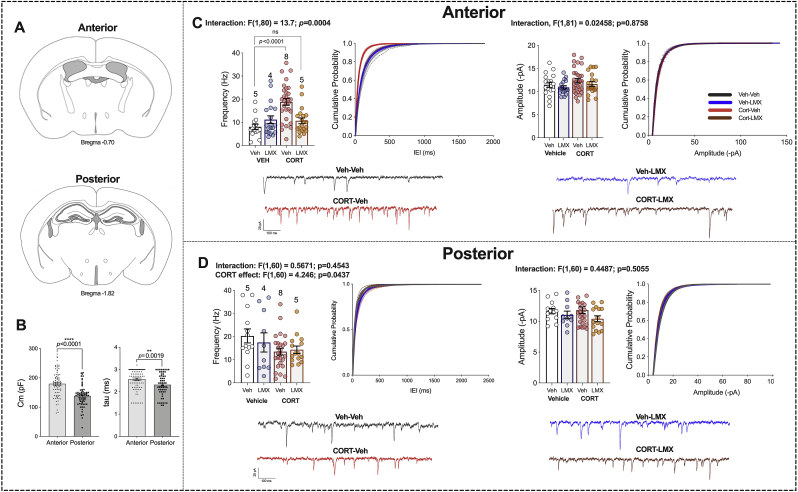
Chronic LMX treatment prevents CORT-induced changes in excitatory transmission in anterior BLA. (a) Representative depiction comparing anterior BLA to posterior BLA. (b) Comparison of mean membrane capacitance (Cm; ****, p < 0.0001) and time constant (tau; **, p < 0.01) of pyramidal neurons from anterior and posterior BLA slices (c) Spontaneous EPSC (sEPSC) frequency (left) and amplitude (right) recorded from pyramidal neurons in anterior BLA and representative traces from each group (bottom). (d) sEPSC frequency (left) and amplitude (right) from posterior BLA principal neurons and representative traces (bottom). F and p-values for two-way ANOVA shown above (c–d). P values shown for pairwise comparisons derived from Holm-Sidak multiple comparisons test after ANOVA or unpaired student's two-tailed t-test (b). For cumulative probability curves, p < 0.0001 by K–S test. Each point represents one cell. Data are presented as mean ± SEM.

References

    1. Akhondzadeh S., Jafari S., Raisi F., Nasehi A.A., Ghoreishi A., Salehi B., Mohebbi-Rasa S., Raznahan M., Kamalipour A. Clinical trial of adjunctive celecoxib treatment in patients with major depression: a double blind and placebo controlled trial. Depress. Anxiety. 2009;26(7):607–611. - PubMed
    1. Alevizos M., Karagkouni A., Panagiotidou S., Vasiadi M., Theoharides T.C. Stress triggers coronary mast cells leading to cardiac events. Ann. Allergy Asthma Immunol. 2014;112(4):309–316. - PMC - PubMed
    1. Animals, C. f. t. U. o. t. G. f. t. C. a. U. o. L . Institute for Laboratory Animal Research; Washington, D.C.: 2011. Guide for the Care and Use of Laboratory Animals; pp. 1–246. 2011.
    1. Artigas F., Bortolozzi A., Celada P. Can we increase speed and efficacy of antidepressant treatments? Part I: general aspects and monoamine-based strategies. Eur. Neuropsychopharmacol. 2018;28(4):445–456. - PubMed
    1. Bedse G., Bluett R.J., Patrick T.A., Romness N.K., Gaulden A.D., Kingsley P.J., Plath N., Marnett L.J., Patel S. Therapeutic endocannabinoid augmentation for mood and anxiety disorders: comparative profiling of FAAH, MAGL and dual inhibitors. Transl. Psychiatry. 2018;8(1):92. - PMC - PubMed