


Real-time visualization of titin dynamics reveals extensive reversible photobleaching in human induced pluripotent stem cell-derived cardiomyocytes
- PMID: 31747312
- PMCID: PMC6985833
- DOI: 10.1152/ajpcell.00107.2019
Real-time visualization of titin dynamics reveals extensive reversible photobleaching in human induced pluripotent stem cell-derived cardiomyocytes
Abstract
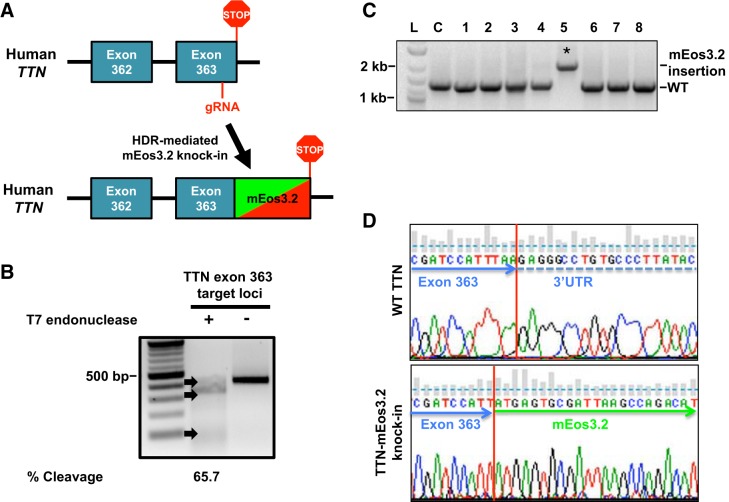
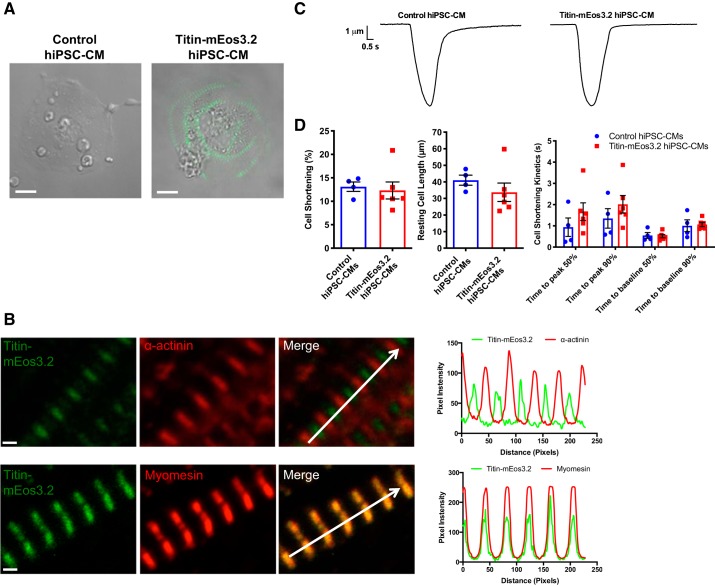
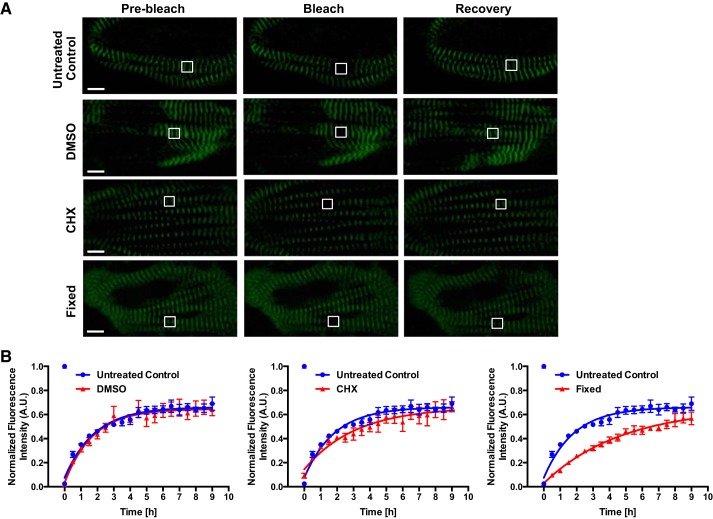
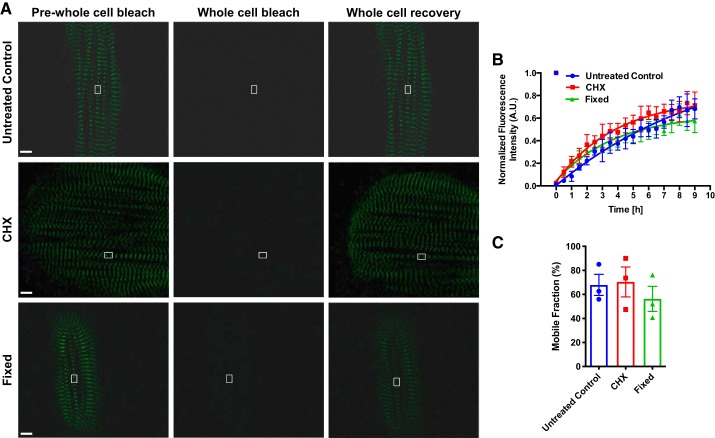
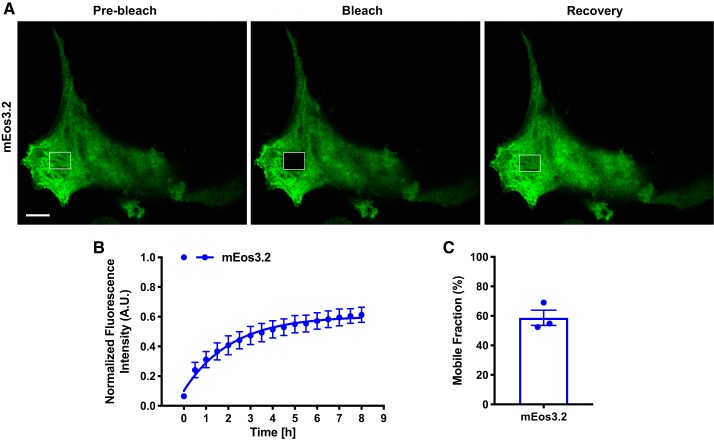
Fluorescence recovery after photobleaching (FRAP) has been useful in delineating cardiac myofilament biology, and innovations in fluorophore chemistry have expanded the array of microscopic assays used. However, one assumption in FRAP is the irreversible photobleaching of fluorescent proteins after laser excitation. Here we demonstrate reversible photobleaching regarding the photoconvertible fluorescent protein mEos3.2. We used CRISPR/Cas9 genome editing in human induced pluripotent stem cells (hiPSCs) to knock-in mEos3.2 into the COOH terminus of titin to visualize sarcomeric titin incorporation and turnover. Upon cardiac induction, the titin-mEos3.2 fusion protein is expressed and integrated in the sarcomeres of hiPSC-derived cardiomyocytes (CMs). STORM imaging shows M-band clustered regions of bound titin-mEos3.2 with few soluble titin-mEos3.2 molecules. FRAP revealed a baseline titin-mEos3.2 fluorescence recovery of 68% and half-life of ~1.2 h, suggesting a rapid exchange of sarcomeric titin with soluble titin. However, paraformaldehyde-fixed and permeabilized titin-mEos3.2 hiPSC-CMs surprisingly revealed a 55% fluorescence recovery. Whole cell FRAP analysis in paraformaldehyde-fixed, cycloheximide-treated, and untreated titin-mEos3.2 hiPSC-CMs displayed no significant differences in fluorescence recovery. FRAP in fixed HEK 293T expressing cytosolic mEos3.2 demonstrates a 58% fluorescence recovery. These data suggest that titin-mEos3.2 is subject to reversible photobleaching following FRAP. Using a mouse titin-eGFP model, we demonstrate that no reversible photobleaching occurs. Our results reveal that reversible photobleaching accounts for the majority of titin recovery in the titin-mEos3.2 hiPSC-CM model and should warrant as a caution in the extrapolation of reliable FRAP data from specific fluorescent proteins in long-term cell imaging.
Keywords: FRAP; hiPSC-CM; mEos3.2; sarcomere; titin.
Conflict of interest statement
No conflicts of interest, financial or otherwise, are declared by the authors.
Figures
References
-
- Bang ML, Centner T, Fornoff F, Geach AJ, Gotthardt M, McNabb M, Witt CC, Labeit D, Gregorio CC, Granzier H, Labeit S. The complete gene sequence of titin, expression of an unusual approximately 700-kDa titin isoform, and its interaction with obscurin identify a novel Z-line to I-band linking system. Circ Res 89: 1065–1072, 2001. doi: 10.1161/hh2301.100981. - DOI - PubMed
Publication types
MeSH terms
Substances
Grants and funding
LinkOut - more resources
Full Text Sources
Research Materials
Miscellaneous
