. 2023 Nov 21;4(11):101267.
doi: 10.1016/j.xcrm.2023.101267. Epub 2023 Nov 6.

SARS-CoV-2 antibodies from children exhibit broad neutralization and belong to adult public clonotypes

Affiliations

SARS-CoV-2 antibodies from children exhibit broad neutralization and belong to adult public clonotypes

Steven C Wall et al. Cell Rep Med. .

Abstract

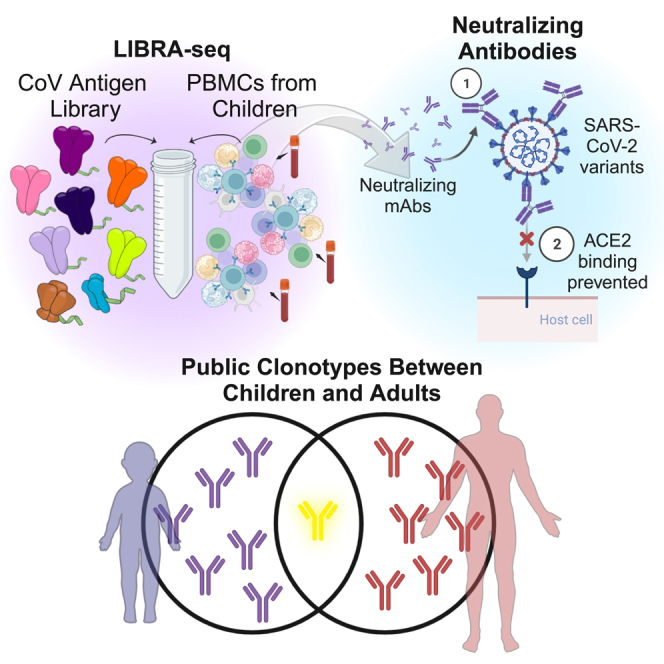
From the beginning of the COVID-19 pandemic, children have exhibited different susceptibility to severe acute respiratory syndrome coronavirus 2 (SARS-CoV-2) infection, reinfection, and disease compared with adults. Motivated by the established significance of SARS-CoV-2-neutralizing antibodies in adults, here we characterize SARS-CoV-2-specific antibody repertoires in a young cohort of individuals aged from 5 months to 18 years old. Our results show that neutralizing antibodies in children possess similar genetic features compared to antibodies identified in adults, with multiple antibodies from children belonging to previously established public antibody clonotypes in adults. Notably, antibodies from children show potent neutralization of circulating SARS-CoV-2 variants that have cumulatively resulted in resistance to virtually all approved monoclonal antibody therapeutics. Our results show that children can rely on similar SARS-CoV-2 antibody neutralization mechanisms compared to adults and are an underutilized source for the discovery of effective antibody therapeutics to counteract the ever-evolving pandemic.

Keywords: B cells; SARS-CoV-2; antibodies; children; infection; neutralization; public clonotype; virus.


Conflict of interest statement

Declaration of interests S.C.W. and I.S.G. are listed as inventors on antibodies described here. A.R.S. and I.S.G. are co-founders of AbSeek Bio. I.S.G. and A.R.S. are listed as inventors on patent applications for the LIBRA-seq technology. D.J.S. has served as a consultant for AstraZeneca AB. J.E.C. has served as a consultant for Luna Biologics, is a member of the Scientific Advisory Board of Meissa Vaccines, and is founder of IDBiologics. The Crowe laboratory has received funding support in sponsored research agreements from AstraZeneca, IDBiologics, and Takeda. The Georgiev laboratory at VUMC has received unrelated funding from Takeda Pharmaceuticals.

Figures
None
Graphical abstract
Figure 1
Figure 1
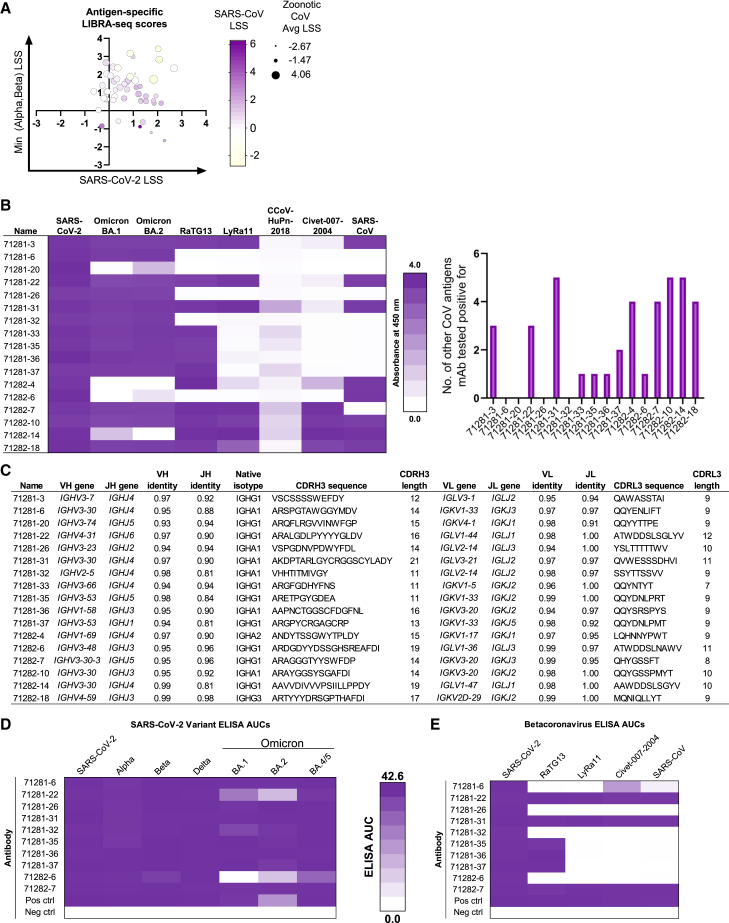
Using LIBRA-seq with a diverse CoV antigen panel to discover antibodies from children’s samples (A) 59 IgG and IgA cells identified by LIBRA-seq are shown as circles, with their respective LIBRA-seq scores (LSSs) for SARS-CoV-2 (x axis), minimum score for the Alpha and Beta SARS-CoV-2 variants (y axis), and SARS-CoV (color heatmap) and average score for the potentially zoonotic CoV spikes used in the LIBRA-seq library (size of circle). (B) Recombinant antibodies were produced by microexpression and screened by ELISA against a panel of recombinant CoV spike antigens. For the antibodies that were positive for SARS-CoV-2 spike binding, shown are (left) a binding heatmap for each antibody (rows) against a panel of SARS-CoV-2 variants and other coronaviruses (columns) and (right) the number of non-SARS-CoV-2 antigens (y axis) that each antibody (x axis) was able to recognize. (C) For each antibody (rows), shown are the CDR amino acid sequences and lengths, V-gene and J-gene and percentage of nucleotide identities, and isotype (columns). (D and E) ELISA area under the curve (AUC) values from purified monoclonal antibody binding to (D) SARS-CoV-2 variant spike proteins and (E) other betacoronavirus spike proteins are shown as heatmaps from minimum (white) to maximum (purple) binding. ELISA controls are described in Figure S2.
Figure 2
Figure 2
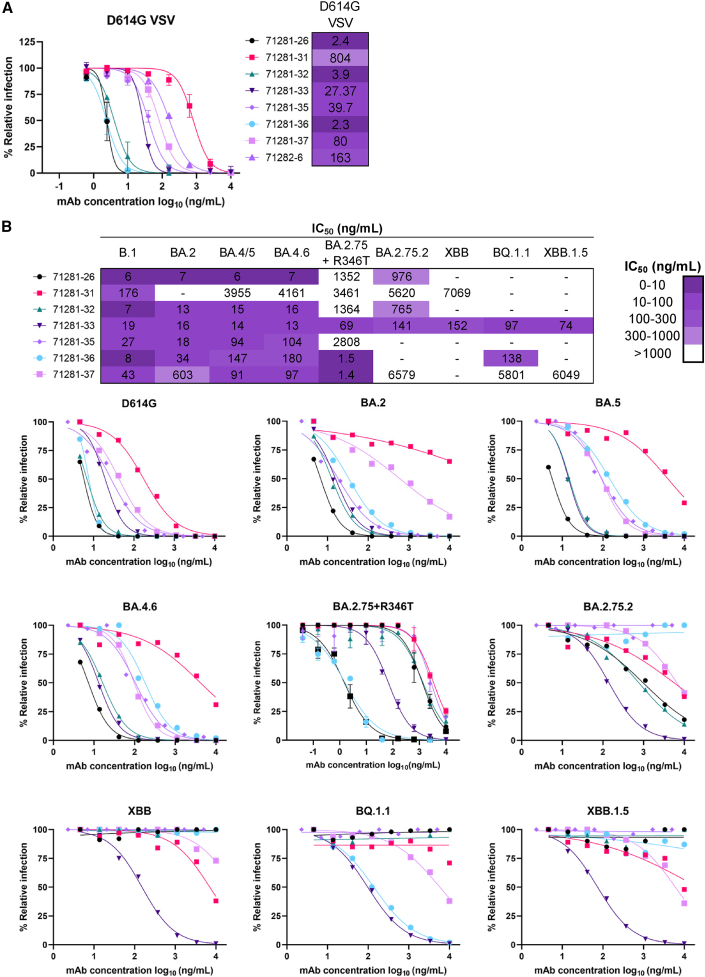
Antibodies from children show diverse neutralization profiles of SARS-CoV-2 variants (A) SARS-CoV-2 VSV-G neutralization was performed for a panel of antibodies against SARS-CoV-2 VSV-G with the D614G mutation. (B) Additional lentiviral pseudovirus neutralization assays were performed against SARS-CoV-2 D614G and Omicron variants (BA.2, BA.4/5, BA.4.6, BA.2.75.2, BA.2.75+R346T, XBB, XBB.1.5, and BQ1.1). The IC50 values calculated in GraphPad Prism software by four-parameter best-fit analysis are shown on the bottom right as a color heatmap from least (white) to most (purple) potent. Data represent the percentage of neutralization or relative infection as mean ± SD; data are representative of at least two independent experiments performed in technical duplicate.
Figure 3
Figure 3
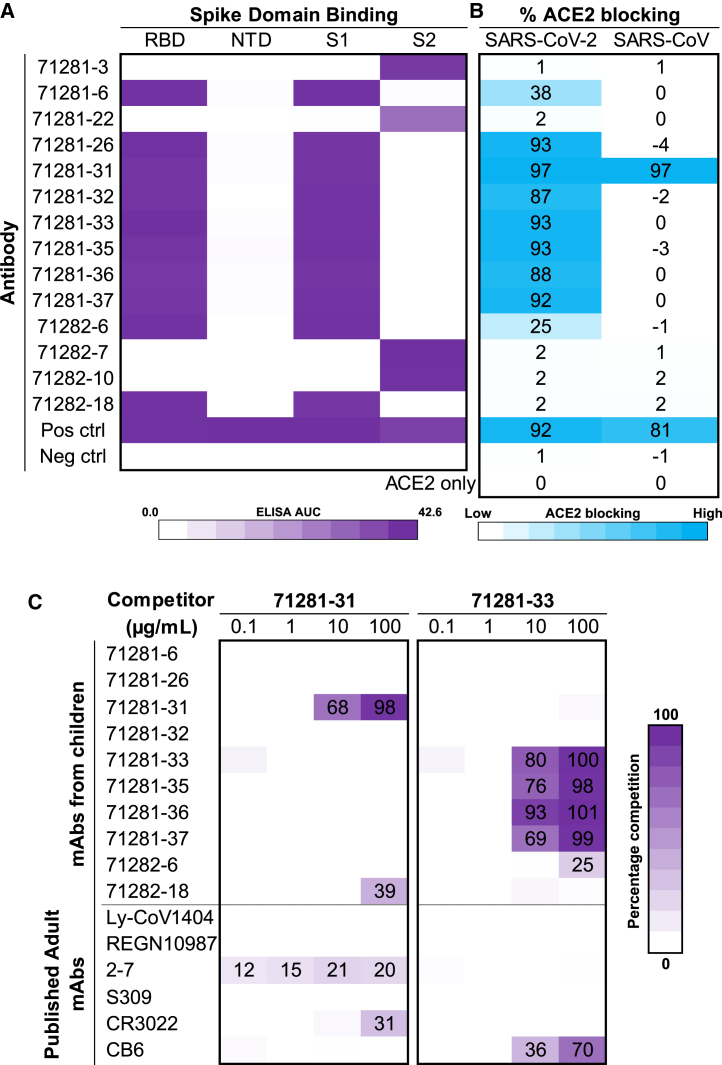
Epitope and ACE2-blocking analysis of antibodies from children (A) ELISA AUC values for recombinant SARS-CoV-2 spike antigen domains are shown as heatmaps from minimum (white) to maximum (purple) binding. Controls are described in Figure S2B. (B) Percentage of ACE2 blocking by ELISA is shown for SARS-CoV-2 and SARS-CoV spike proteins and is depicted as a heatmap from 0% (white) to 100% (blue). (C) Antibody-antibody competition ELISAs were performed for antibodies 71281-31 and 71281-33 against other child antibodies identified here, as well as previously published adult antibodies. Percentage of competition is shown as a heatmap from 0% (white) to 100% (purple). Non-biotinylated competitor antibodies were coated first, and then biotinylated 71281-31 and 71281-33 were added to detect competition, as described in more detail in the STAR Methods.
Figure 4
Figure 4
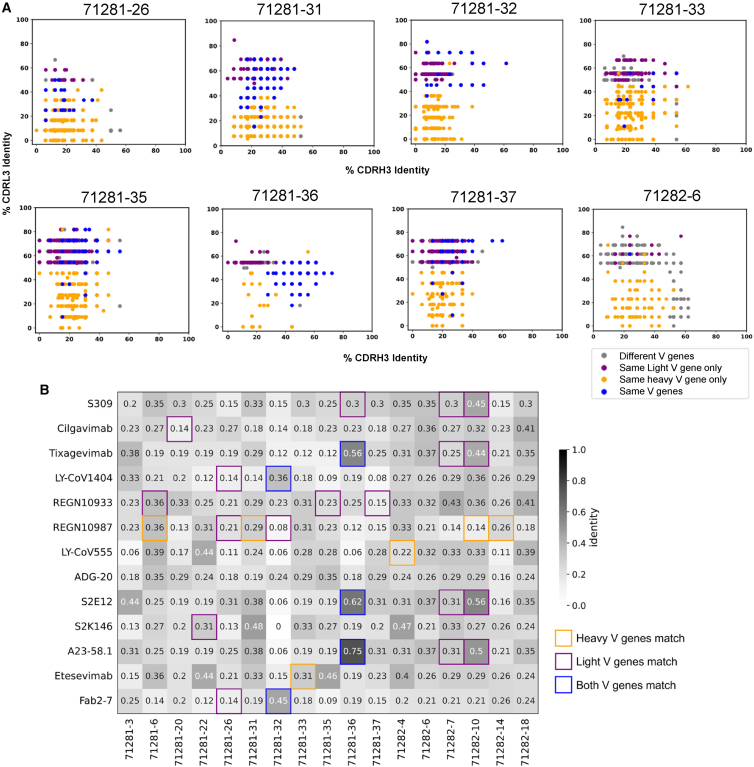
Public clonotype analysis of SARS-CoV-2 antibodies from children (A) For each antibody from children (separate plot), shown are previously published adult antibodies (dots), with the respective CDRH3 (x axis) and CDRL3 (y axis) identity, colored according to V-gene usage: blue if both the VH and VL genes of the given child and adult antibodies match, orange if only the VH genes match, purple if only the VL genes match, and gray if neither match but at least one of the CDRH3 and CDRL3 have >50% sequence identity for the child vs. adult antibody. (B) For each antibody from children (column), shown is the CDRH3 identity (values; heatmap) against a set of adult antibodies in clinical use or advanced preclinical development (rows). Cell border color corresponds to the V-gene usage described in (A).

References

    1. Ruf B.R., Knuf M. The burden of seasonal and pandemic influenza in infants and children. Eur. J. Pediatr. 2014;173:265–276. doi: 10.1007/s00431-013-2023-6. - DOI - PMC - PubMed
    1. Shafagati N., Williams J. Human metapneumovirus - what we know now. F1000Res. 2018;7:135. doi: 10.12688/f1000research.12625.1. - DOI - PMC - PubMed
    1. Shi T., McAllister D.A., O'Brien K.L., Simoes E.A.F., Madhi S.A., Gessner B.D., Polack F.P., Balsells E., Acacio S., Aguayo C., et al. Global, regional, and national disease burden estimates of acute lower respiratory infections due to respiratory syncytial virus in young children in 2015: a systematic review and modelling study. Lancet. 2017;390:946–958. doi: 10.1016/s0140-6736(17)30938-8. - DOI - PMC - PubMed
    1. Zimmermann P., Curtis N. Why is COVID-19 less severe in children? A review of the proposed mechanisms underlying the age-related difference in severity of SARS-CoV-2 infections. Arch. Dis. Child. 2020;106:429–439. doi: 10.1136/archdischild-2020-320338. - DOI - PubMed
    1. Mehta N.S., Mytton O.T., Mullins E.W.S., Fowler T.A., Falconer C.L., Murphy O.B., Langenberg C., Jayatunga W.J.P., Eddy D.H., Nguyen-Van-Tam J.S. SARS-CoV-2 (COVID-19): What Do We Know About Children? A Systematic Review. Clin. Infect. Dis. 2020;71:2469–2479. doi: 10.1093/cid/ciaa556. - DOI - PMC - PubMed

Publication types

Supplementary concepts