. 2021 Jun;7(6):000292.
doi: 10.1099/mgen.0.000292.

Molecular characterization of respiratory syncytial viruses circulating in a paediatric cohort in Amman, Jordan

Affiliations

Molecular characterization of respiratory syncytial viruses circulating in a paediatric cohort in Amman, Jordan

Nídia S Trovão et al. Microb Genom. 2021 Jun.

Abstract

Respiratory syncytial viruses (RSVs) are an important cause of mortality worldwide and a major cause of respiratory tract infections in children, driving development of vaccine candidates. However, there are large gaps in our knowledge of the local evolutionary and transmission dynamics of RSVs, particularly in understudied regions such as the Middle East. To address this gap, we sequenced the complete genomes of 58 RSVA and 27 RSVB samples collected in a paediatric cohort in Amman, Jordan, between 2010 and 2013. RSVA and RSVB co-circulated during each winter epidemic of RSV in Amman, and each epidemic comprised multiple independent viral introductions of RSVA and RSVB. However, RSVA and RSVB alternated in dominance across years, potential evidence of immunological interactions. Children infected with RSVA tended to be older than RSVB-infected children [30 months versus 22.4 months, respectively (P value = 0.02)], and tended to developed bronchopneumonia less frequently than those with RSVB, although the difference was not statistically significant (P value = 0.06). Differences in spatial patterns were investigated, and RSVA lineages were often identified in multiple regions in Amman, whereas RSVB introductions did not spread beyond a single region of the city, although these findings were based on small sample sizes. Multiple RSVA genotypes were identified in Amman, including GA2 viruses as well as three viruses from the ON1 sub-genotype that emerged in 2009 and are now the dominant genotype circulating worldwide. As vaccine development advances, further sequencing of RSV is needed to understand viral ecology and transmission, particularly in under-studied locations.

Keywords: Bayesian analysis; evolution; next-generation sequencing; paediatric cohort; phylogenetic analysis; respiratory syncytial virus.


Conflict of interest statement

The authors declare that there are no conflicts of interest.

Figures
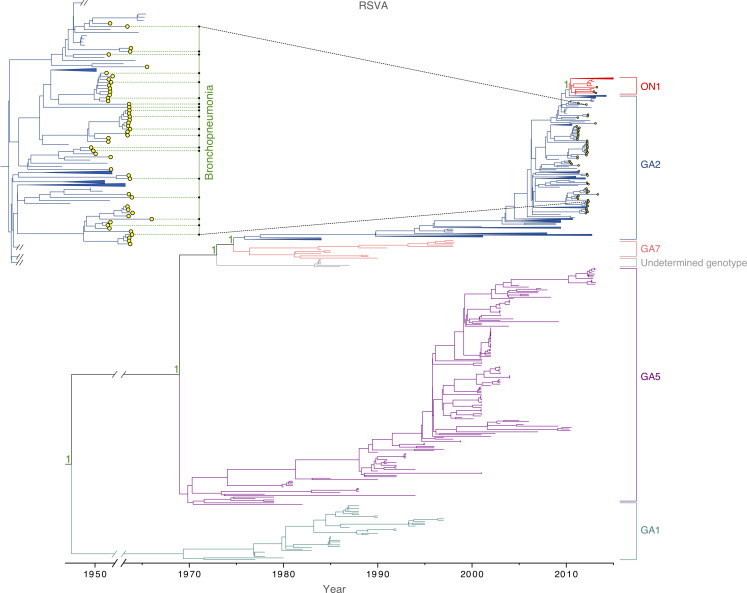
Fig. 1.
Fig. 1.
Global RSVA phylogeny. MCC tree inferred for 669 viruses sampled globally, coloured by genotype. The yellow-filled circles indicate 58 samples collected from a paediatric cohort in Amman, Jordan, which cluster within the GA2 genotype and ON1 sub-genotype. A few tips from countries other than Jordan are collapsed for visual clarity. Green dotted lines indicate samples from patients with bronchopneumonia. Posterior probabilities are indicated as support for nodes defining a genotype. A more detailed tree of RSVA samples collected in Amman is provided in Fig. 4.
Fig. 2.
Fig. 2.
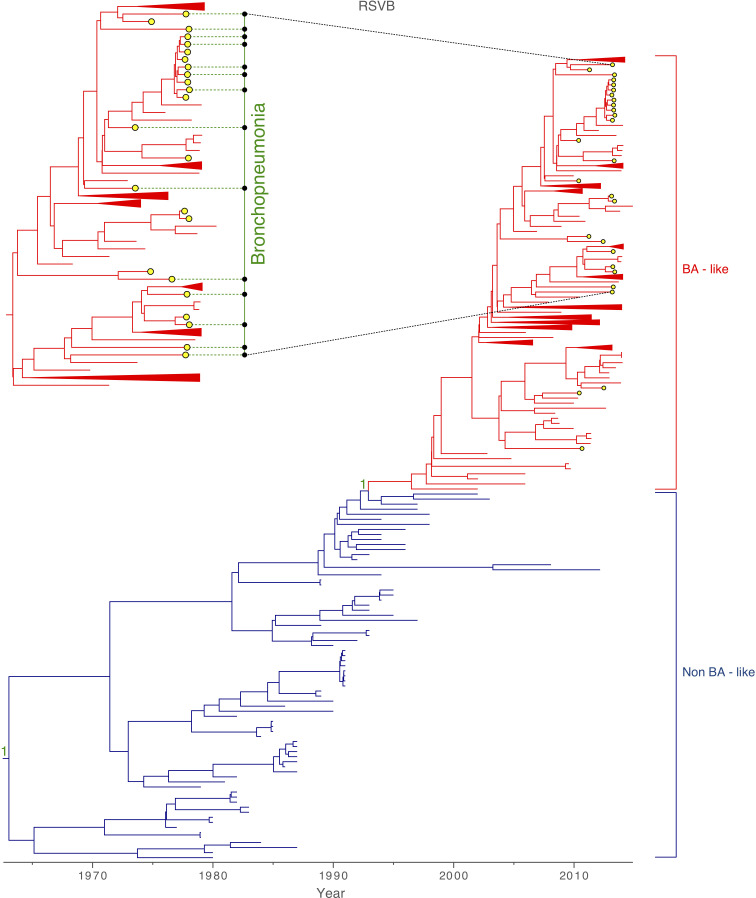
Global RSVB phylogeny. MCC tree inferred for 327 viruses sampled globally, coloured by genotype. The yellow-filled circles indicate 27 samples collected from a paediatric cohort in Amman, Jordan, which cluster within the GB1 sub-genotype positioned within the BA-like clade. A few tips from countries other than Jordan are collapsed for visual clarity. Green dotted lines indicate samples from patients with bronchopneumonia. Posterior probabilities are indicated as support for nodes defining a genotype. A more detailed tree of RSVB samples collected in Amman is provided in Fig. 4.
Fig. 3.
Fig. 3.
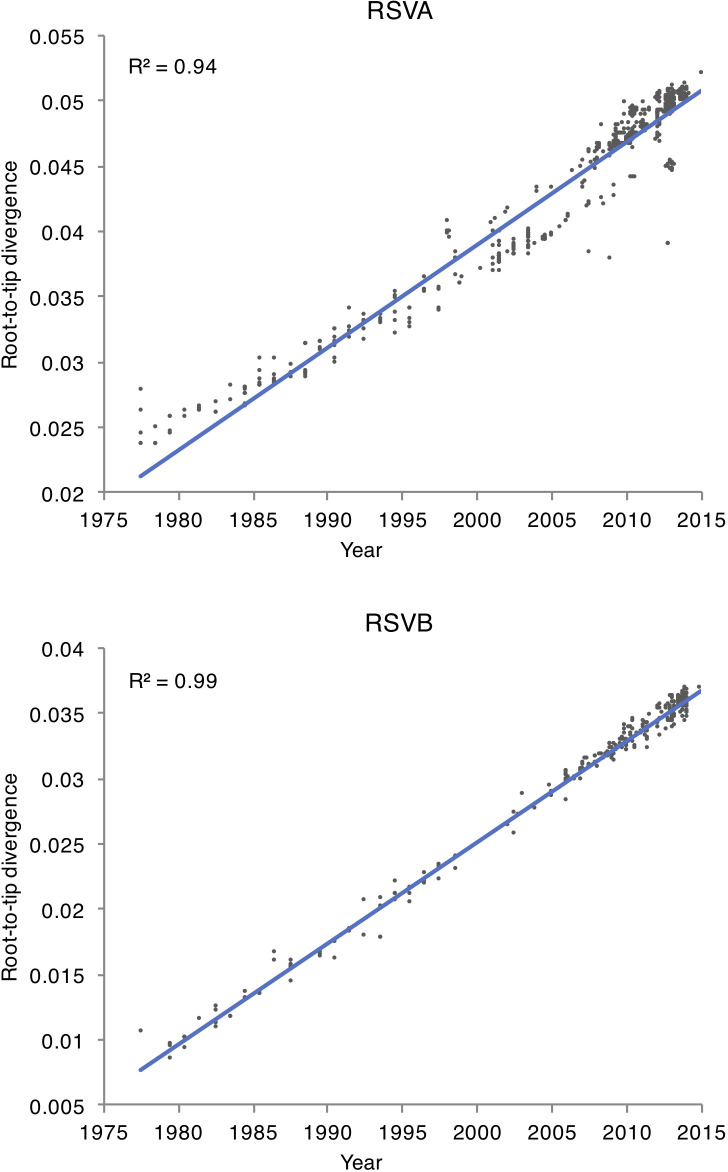
Root-to-tip divergence. A plot of sampling time versus genetic distance, inferred from trees of RSVA and RSVB inferred using maximum-likelihood methods. Both RSVA and RSVB datasets display a strong temporal signal for a molecular clock, as shown by the high R 2.
Fig. 4.
Fig. 4.
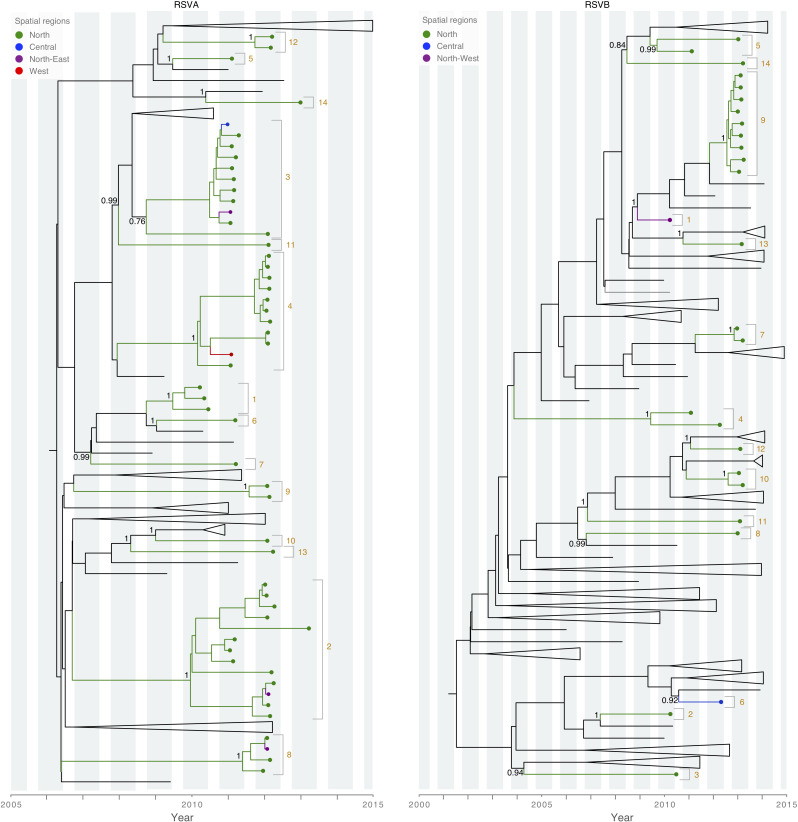
Spatial patterns of RSV introductions in Amman, Jordan. Truncated MCC trees (RSVA, left; RSVB, right) with tip labels coloured by spatial region in Amman, Jordan. Tips from countries other than Jordan are collapsed for visual clarity. Discrete viral introductions are numbered, similarly to Tables 2 and 3, and shaded orange. Node support is indicated for posterior probabilities >0.75. Vertical grey bars indicate RSV epidemic seasons in Jordan, according to Halasa et al. [40].
Fig. 5.
Fig. 5.
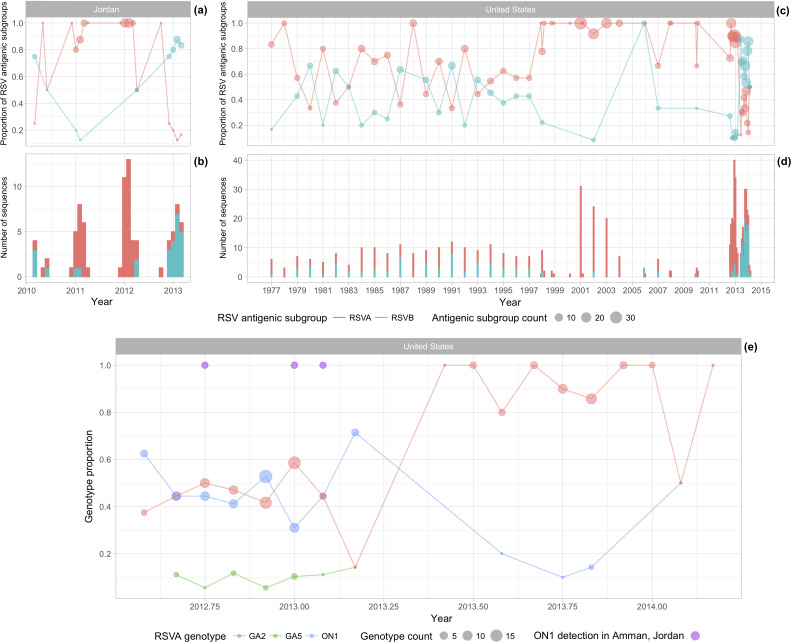
Circulation of RSV in Jordan and the USA. The proportion of all available full-genome RSV sequences aggregated by antigenic subgroup for Jordan collected from 2010 to 2013 (a), for the USA from 1977 to 2014 (c) and aggregated by genotype for the USA from 2012 to 2014 (e). Circle sizes represent the number of sequences from each antigenic subgroup (a and c) or genotype (e) contributing to the proportion. Total number of RSV sequences from Jordan collected from 2010 to 2013 (b) and from the USA from 1977 to 2014 (d). Purple circles represent dates when genotype ON1 was identified in Amman, Jordan.

References

    1. Shi T, McAllister DA, O'Brien KL, Simoes EAF, Madhi SA, et al. Global, regional, and national disease burden estimates of acute lower respiratory infections due to respiratory syncytial virus in young children in 2015: a systematic review and modelling study. The Lancet. 2017;390:946–958. doi: 10.1016/S0140-6736(17)30938-8. - DOI - PMC - PubMed
    1. Ogra PL. Respiratory syncytial virus: the virus, the disease and the immune response. Paediatr Respir Rev. 2004;5:S119–S126. doi: 10.1016/S1526-0542(04)90023-1. - DOI - PMC - PubMed
    1. Falsey AR, Walsh EE. Respiratory syncytial virus infection in elderly adults. Drugs Aging. 2005;22:577–587. doi: 10.2165/00002512-200522070-00004. - DOI - PMC - PubMed
    1. Lee N, Lui GCY, Wong KT, Li TCM, Tse ECM, et al. High morbidity and mortality in adults hospitalized for respiratory syncytial virus infections. Clin Infect Dis. 2013;57:1069–1077. doi: 10.1093/cid/cit471. - DOI - PubMed
    1. Falsey AR, McElhaney JE, Beran J, van Essen GA, Duval X, et al. Respiratory syncytial virus and other respiratory viral infections in older adults with moderate to severe influenza-like illness. J Infect Dis. 2014;209:1873–1881. doi: 10.1093/infdis/jit839. - DOI - PMC - PubMed

Publication types