. 2022 Jun 22;12(1):10547.
doi: 10.1038/s41598-022-14954-9.

Serum anti-malondialdehyde-acetaldehyde IgA antibody concentration improves prediction of coronary atherosclerosis beyond traditional risk factors in patients with rheumatoid arthritis

Affiliations

Serum anti-malondialdehyde-acetaldehyde IgA antibody concentration improves prediction of coronary atherosclerosis beyond traditional risk factors in patients with rheumatoid arthritis

Hannah E Lomzenski et al. Sci Rep. .

Abstract

Patients with rheumatoid arthritis (RA) have increased atherosclerosis; oxidative stress may be a contributor. Oxidative stress produces immunogenic malondialdehyde-acetaldehyde (MAA) protein adducts and anti-MAA antibodies are detectable in human serum. We hypothesized that anti-MAA antibody concentrations are associated with coronary atherosclerosis in RA patients. Serum concentrations of anti-MAA antibodies (IgA, IgG, and IgM) were measured in 166 RA patients using ELISA cross-sectionally. Relationship between anti-MAA antibody concentrations and cardiovascular and metabolic measures and predictive accuracy of anti-MAA antibodies for presence of coronary artery calcium (CAC) and high CAC (≥ 300 Agatston units or ≥ 75th percentile) were assessed. Only serum IgA anti-MAA antibody concentration was associated with increased CAC, insulin resistance, and decreased high-density lipoprotein particle number. When added as an interaction term with ACC/AHA 10-year risk score plus high-sensitivity C-reactive protein, IgA anti-MAA antibody concentration improved the C-statistic for prediction of any CAC and high CAC compared to ACC/AHA 10-year risk score plus hs-CRP alone. IgA anti-MAA concentration is associated with multiple cardiovascular risk factors and modifies the relationship between ACC/AHA 10-year risk score and CAC in RA patients. IgA anti-MAA concentration could assist in prediction of atherosclerotic CVD and risk stratification when added to standard measures of cardiovascular risk.


Conflict of interest statement

The authors declare no competing interests.

Figures

Figure 1
Figure 1
Plots of anti-MAA antibody isotype concentrations based on coronary artery calcium in patients with rheumatoid arthritis. Box demonstrates the median, upper and lower quartiles. Whiskers represent 95% confidence intervals. CAC = coronary artery calcium. High CAC = high coronary artery calcium score based on ≥ 300 Agatston units or ≥ 75th percentile for age, sex, and ethnicity. AU = arbitrary units. Serum anti-MAA IgA concentrations were significantly higher among those with CAC compared to those without CAC (Panel A, P = 0.04), and significantly higher among those with high CAC compared to low CAC (Panel A, P = 0.003). Anti-MAA IgG and IgM serum concentrations were not significantly altered based on CAC (Panels B and C, all P > 0.05).
Figure 2
Figure 2
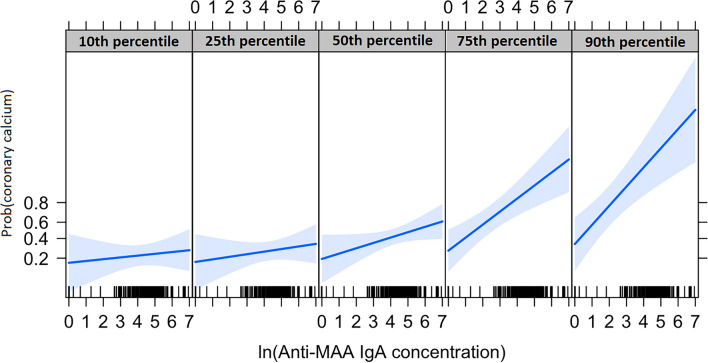
The interaction between anti-MAA IgA concentration and ACC/AHA 10-year risk score in predicting the presence of coronary artery calcium. Percentiles refer to the ACC/AHA 10-year risk score percentile of the RA patients. At higher ACC/AHA 10-year risk score, shown as 75th and 90th percentiles, presence of elevated anti-MAA IgA was associated with an amplified probability of coronary calcium.

References

    1. Rho YH, Chung CP, Oeser A, et al. Interaction between oxidative stress and high-density lipoprotein cholesterol is associated with severity of coronary artery calcification in rheumatoid arthritis. Arthritis Care Res. (Hoboken). 2010;62(10):1473–1480. doi: 10.1002/acr.20237. - DOI - PMC - PubMed
    1. Mateen S, Moin S, Khan AQ, Zafar A, Fatima N. Increased reactive oxygen species formation and oxidative stress in rheumatoid arthritis. PLoS ONE. 2016;11(4):e0152925. doi: 10.1371/journal.pone.0152925. - DOI - PMC - PubMed
    1. Tuma DJ, Kearley ML, Thiele GM, et al. Elucidation of reaction scheme describing malondialdehyde-acetaldehyde-protein adduct formation. Chem. Res. Toxicol. 2001;14(7):822–832. doi: 10.1021/tx000222a. - DOI - PubMed
    1. Thiele GM, Tuma DJ, Willis MS, et al. Soluble proteins modified with acetaldehyde and malondialdehyde are immunogenic in the absence of adjuvant. Alcohol Clin. Exp. Res. 1998;22(8):1731–1739. doi: 10.1111/j.1530-0277.1998.tb03973.x. - DOI - PubMed
    1. Hill GE, Miller JA, Baxter BT, et al. Association of malondialdehyde-acetaldehyde (MAA) adducted proteins with atherosclerotic-induced vascular inflammatory injury. Atherosclerosis. 1998;141(1):107–116. doi: 10.1016/S0021-9150(98)00153-1. - DOI - PubMed

Publication types