


Observational Study of the Effect of Patient Outreach on Return to Care: The Earlier the Better
- PMID: 28604501
- PMCID: PMC5597469
- DOI: 10.1097/QAI.0000000000001474
Observational Study of the Effect of Patient Outreach on Return to Care: The Earlier the Better
Abstract
Background: The burden of HIV remains heaviest in resource-limited settings, where problems of losses to care, silent transfers, gaps in care, and incomplete mortality ascertainment have been recognized.
Methods: Patients in care at Academic Model Providing Access to Healthcare (AMPATH) clinics from 2001-2011 were included in this retrospective observational study. Patients missing an appointment were traced by trained staff; those found alive were counseled to return to care (RTC). Relative hazards of RTC were estimated among those having a true gap: missing a clinic appointment and confirmed as neither dead nor receiving care elsewhere. Sample-based multiple imputation accounted for missing vital status.
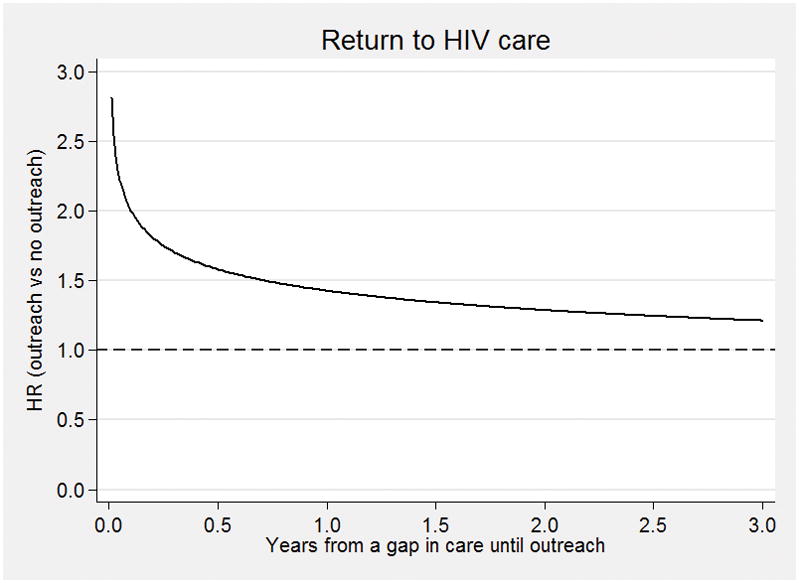
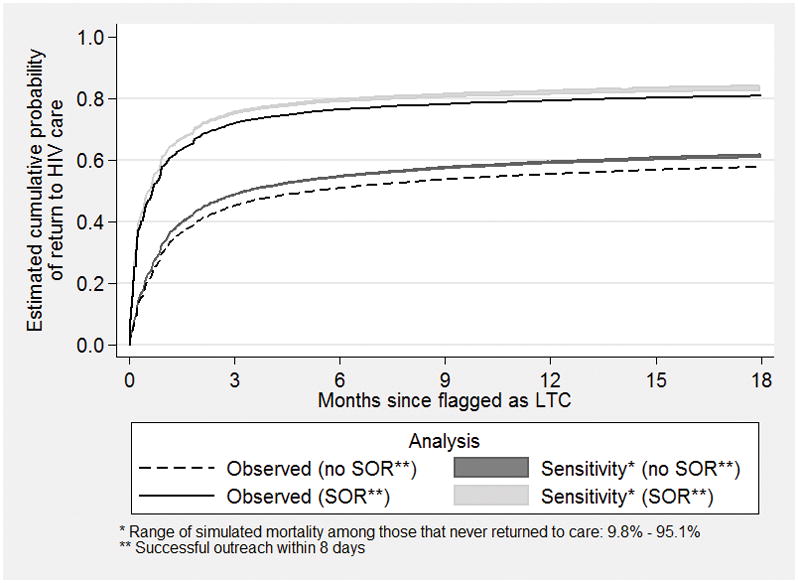
Results: Among 34,522 patients lost to clinic, 15,331 (44.4%) had a true gap per outreach, 2754 (8.0%) were deceased, and 837 (2.4%) had documented transfers. Of 15,600 (45.2%) remaining without active ascertainment, 8762 (56.2%) with later RTC were assumed to have a true gap. Adjusted cause-specific hazard ratios (aHRs) showed early outreach (a ≤8-day window, defined by grid-search approach) had twice the hazard for RTC vs. those without (aHR = 2.06; P < 0.001). HRs for RTC were lower the later the outreach effort after disengagement (aHR = 0.86 per unit increase in time; P < 0.001). Older age, female sex (vs. male), antiretroviral therapy use (vs. none), and HIV status disclosure (vs. none) were also associated with greater likelihood of RTC, and higher enrollment CD4 count with lower likelihood of RTC.
Conclusion: Patient outreach efforts have a positive impact on patient RTC, regardless of when undertaken, but particularly soon after the patient misses an appointment.
Figures
References
-
- UNAIDS. AIDS by the numbers: AIDS is not over, but it can be. Geneva: Joint United Nations Programme on HIV/AIDS; 2016.
-
- World Health Organization. Consolidated guidelines on the use of antiretroviral drugs for treating and preventing HIV infection. 2013 - PubMed
Publication types
MeSH terms
Substances
Grants and funding
LinkOut - more resources
Full Text Sources
Other Literature Sources
Medical
Research Materials
Miscellaneous
