. 2021 Nov;14(11):101213.
doi: 10.1016/j.tranon.2021.101213. Epub 2021 Aug 27.

Blocking GRP/GRP-R signaling decreases expression of androgen receptor splice variants and inhibits tumor growth in castration-resistant prostate cancer

Affiliations

Blocking GRP/GRP-R signaling decreases expression of androgen receptor splice variants and inhibits tumor growth in castration-resistant prostate cancer

Thomas C Case et al. Transl Oncol. 2021 Nov.

Abstract

Clinical management of castration-resistant prostate cancer (CRPC) resulting from androgen deprivation therapy (ADT) remains challenging. Many studies indicate that androgen receptor splice variants (ARVs) play a critical role in the development of CRPC, including resistance to the new generation of inhibitors of androgen receptor (AR) action. ARVs are constitutively active and lack the ligand-binding domain (LBD), thereby allowing prostate cancer (PC) to maintain AR activity despite therapies that target the AR (full-length AR; AR-FL). Previously, we have reported that long-term ADT increases the neuroendocrine (NE) hormone - Gastrin Releasing Peptide (GRP) and its receptor (GRP-R) expression in PC cells. Further, we demonstrated that activation of GRP/GRP-R signaling increases ARVs expression by activating NF-κB signaling, thereby promoting cancer progression to CRPC. Most importantly, as a cell surface protein, GRP-R is easily targeted by drugs to block GRP/GRP-R signaling. In this study, we tested if blocking GRP/GRP-R signaling by targeting GRP-R using GRP-R antagonist is sufficient to control CRPC progression. Our studies show that blocking GRP/GRP-R signaling by targeting GRP-R using RC-3095, a selective GRP-R antagonist, efficiently inhibits NF-κB activity and ARVs (AR-V7) expression in CRPC and therapy-induced NEPC (tNEPC) cells. In addition, blocking of GRP/GRP-R signaling by targeting GRP-R can sensitize CRPC cells to anti-androgen treatment (such as MDV3100). Further, preclinical animal studies indicate combination of GRP-R antagonist (targeting ARVs) with anti-androgen (targeting AR-FL) is sufficient to inhibit CRPC and tNEPC tumor growth.

Keywords: Androgen receptor variants; Castration-resistant prostate cancer; GRP/GRP-R; NF-kappa B; neuroendocrine prostate cancer.


Conflict of interest statement

The authors declare no conflict of interest.

Figures
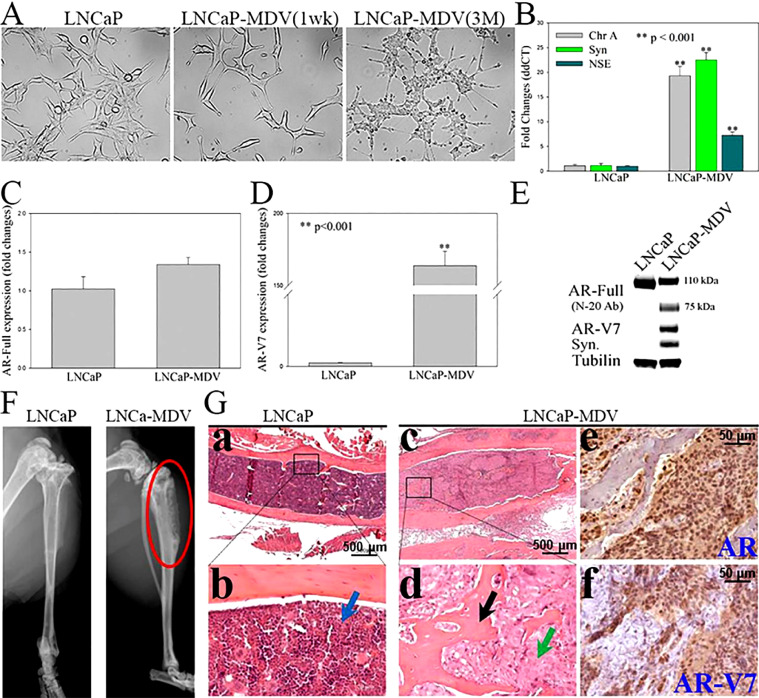
Fig 1
Fig. 1
Long-term ADT reprogrammed PC cells to enable cancer cells to grow in the bone microenvironment. (A) Morphological changes in LNCaP and those treated with MDV3100 (LNCaP-MDV) when observed by light microscopy. (B, C and D) NE markers (Chromogranin A, Synaptophysin and Neuron Specific Enolase), full-length AR (AR-Full) and AR-V7 expression were determined by qPCR. (E) AR-Full (SC, N-20 antibody), AR-V7 and Synaptophysin (Syn) expression were determined by WB. (F & G) LNCaP and LNCaP-MDV (Gc to f) were grafted into the mouse bones by intratibial injection. Tumor formation (red circle) was determined (8 weeks after grafting) by small animal X-ray radiograph imaging (F), H&E and IHC staining of AR, and AR-V7 (Ga,b: LNCaP negative; Gc to f: LNCaP-MDV). Arrow in Gb: bone marrow (blue); in Gd: new bone (black), tumor cells (green). Statistical significance was determined by student's t-test. ** p <0.001.
Fig 2
Fig. 2
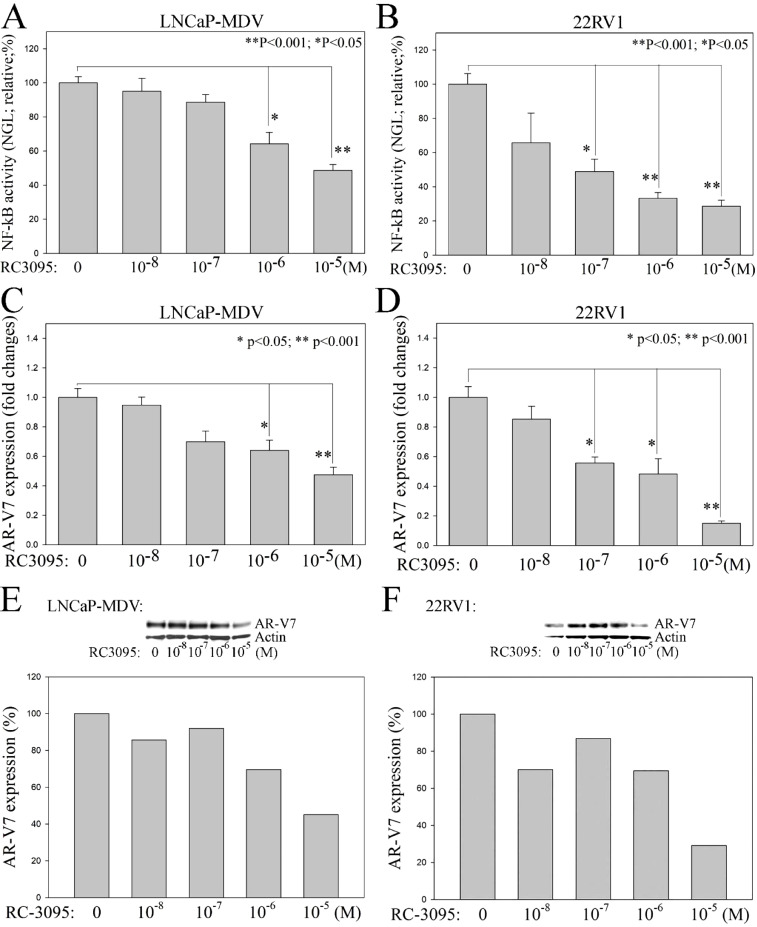
Blocking of GRP/GRP-R signaling efficiently inhibits NF-κB activity and ARVs (AR-V7) expression in PC cells. GRP-R antagonist (RC3095) was used to block GRP/GRP-R signaling in 22RV1 and LNCaP-MDV cells. A and B) NF-κB activity in PC cells was measured using the NGL reporter. C and D) ARVs (AR-V7) expression was determined by qPCR. E and F) ARVs (AR-V7) expression was further confirmed by Western blot analysis. Blot signals were quantified using ImageJ program. Results were normalized by actin signals. Statistical significance was determined by student's t-test. * p <0.05; ** p <0.001.
Fig 3
Fig. 3
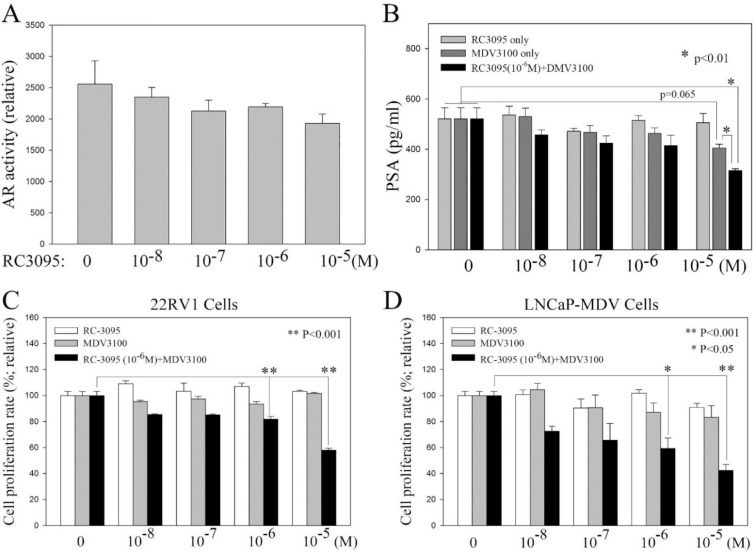
Blocking of GRP/GRP-R signaling increases anti-androgen sensitivity in CRPC cells. A and B) 22RV1 cells were treated with RC3095, MDV3100 or RC3095+MDV3100. AR activity was measured using ARR2PB-Luc vector (A). PSA expression was measured by ELISA assay (B). C and D) 22RV1 (C) and LNCaP-MDV (D) cells were treated with RC-3095, MDV3100 or RC3095+MDV3100. MTT assay was performed at 48 h after the cells had been treated with referenced drugs. Statistical significance was determined by student's t-test. * p <0.05; ** p <0.001.
Fig 4
Fig. 4
Blocking of GRP/GRP-R signaling in combination with ADT is sufficient to control CRPC tumor growth in vivo. 22RV1 cells were placed into the right flank of male athymic nude mice by subcutaneous (s.c.) injection. After the primary tumor formation (about 2-3 weeks), the mice were treated with RC3095 (20ug/day, sc Inj) alone or in combination with ADT for two weeks. Castration (Cx) or MDV3100 (10mg/kg/day, gavage) was used to mimic ADT. Control group mice (Con) were treated with vehicle only. (A) Tumor volume was measured weekly and calculated by the formula: Volume = π/6 × W × H × L (mm3). (B) is showing the tumor volumes at the end point. Results are expressed as the mean percentage change in tumor volume; bars, ± SD. Statistical significance was determined by student's t-test. * p <0.05; ** p <0.001.
Fig 5
Fig. 5
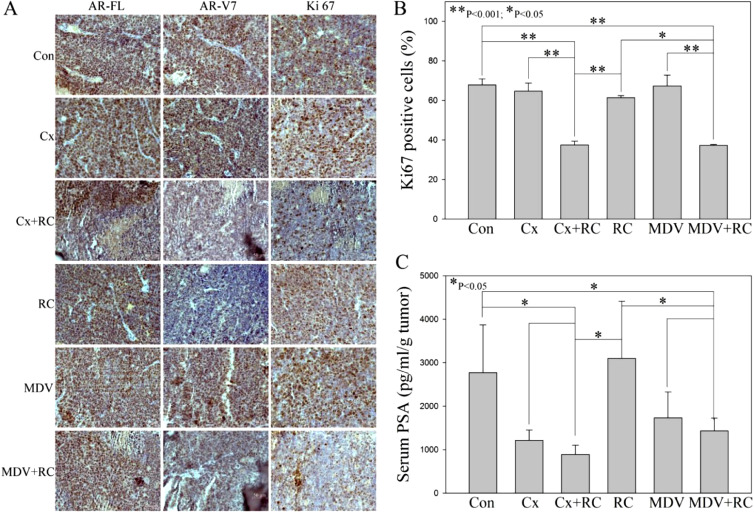
RC3095 efficiently inhibits AR-V7 expression and blocking of GRP/GRP-R signaling in combination with ADT is sufficient to inhibit PSA expression in vivo. A) IHC staining of AR-FL (N-20), AR-V7 and Ki67 were performed. B) Each tissue section was counted manually in three different areas to assess the Ki67 positive cells index. The data were then presented as number of Ki67 positive cells (%). C) Serum PSA levels were measured by ELISA assay. Results are expressed as the means ± SD. Statistical significance was determined by student's t-test. * p <0.05; ** p <0.001.
Fig 6
Fig. 6
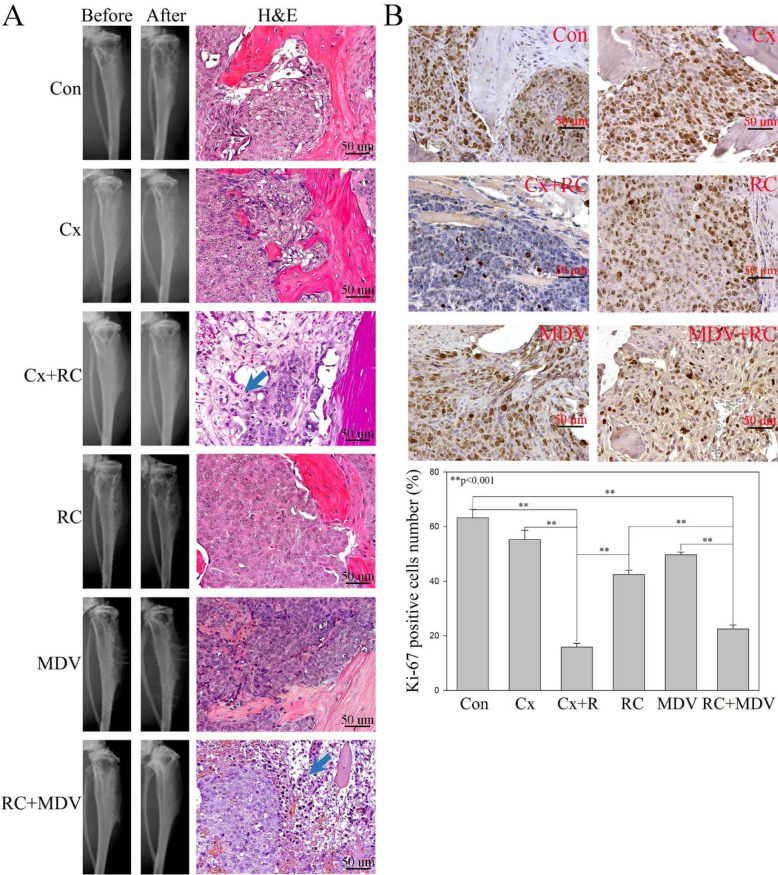
Blocking of GRP/GRP-R signaling in combination with ADT efficiently inhibits tNEPC tumor growth in the bone. LNCaP-MDV cells were placed into the right flank of male athymic nude mice bone by direct intratibial injection. Tumor formation and growth were monitored by a small animal x-ray radiograph once a week. After bone tumor formation (6 weeks after grafting), the mice were treated with RC3095 alone or in combination with ADT for two weeks. A) Tumor formation was confirmed by small animal X-ray radiograph imaging and H&E staining. Blue arrow indicates tumor necrosis area. B) IHC staining of Ki67 was performed. Each tissue section was counted manually in three different areas to assess the Ki67 positive cells index. The data were then presented as percentage of Ki67 positive cells in grafted PC tumor cells. Results are expressed as the means ± SD. Statistical significance was determined by student's t-test. ** p <0.001.

References

    1. Sharifi N, Gulley JL, Dahut WL. Androgen deprivation therapy for prostate cancer. JAMA. 2005;294(2):238–244. - PubMed
    1. Sharifi N, Gulley JL, Dahut WL. An update on androgen deprivation therapy for prostate cancer. Endocr. Relat. Cancer. 2010;17(4):R305–R315. - PMC - PubMed
    1. Lu-Yao GL, Albertsen PC, Moore DF. Fifteen-year survival outcomes following primary androgen-deprivation therapy for localized prostate cancer. JAMA Intern. Med. 2014;174(9):1460–1467. - PMC - PubMed
    1. Dehm SM, Schmidt LJ, Heemers HV, Vessella RL, Tindall DJ. Splicing of a novel androgen receptor exon generates a constitutively active androgen receptor that mediates prostate cancer therapy resistance. Cancer Res. 2008;68(13):5469–5477. - PMC - PubMed
    1. Hu R, Dunn TA, Wei S. Ligand-independent androgen receptor variants derived from splicing of cryptic exons signify hormone-refractory prostate cancer. Cancer Res. 2009;69(1):16–22. - PMC - PubMed